QUESTION 9 (5 marks)
Yellow chromate ions (CrO4
−) are in equilibrium with orange dichromate ions (Cr2O7
2−) in an
aqueous solution.
−(aq) + 2H+(aq) ⇌ Cr2O7
2−(aq) + H2O(l)
2CrO4 Yellow Orange
Two experiments were conducted to investigate the effect of pH on the position of equilibrium.
[CrO4−](mol L−1) | [H+](mol L−1) | [Cr2O72−](mol L−1) | Kc at 25 °C | |
Experiment 1 | 1.0 × 10⁻⁴ | 4.2 × 10¹⁴ | ||
Experiment 2 | 1.2 × 10⁻³ | 6.0 × 10⁻² | 4.2 × 10¹⁴ |


a) Deduce the colour of the solution at equilibrium for experiment 1. Explain your reasoning.
[2 marks]
b) Calculate the pH of the solution at equilibrium for experiment 2. Show your working.
[3 marks]
QCAA guide · typeset solution
QCAA sample response and mark allocation
9a) | Kc is greater than 1; therefore, the equilibrium lies towards the product, so the solution will be orange. | • explains Kc is greater than 1; therefore, equilibrium lies towards the product [1 mark] • deduces that the solution will be orange [1 mark] |
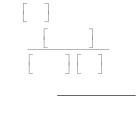
9b) | Let Hx+=22143 22227c246.0 104.2 10(1.2 1)Cr(OCr0)OHKx−−−−+=××=× | • provides appropriate substitution [1 mark] |
• determines [H+] [1 mark] | ||
• calculates pH is 5 [1 mark] |

QCAA sample response and marking criteria reproduced from the official guide.
Compare your working with the guide above.