QUESTION 4 (11 marks)
Bioethanol can be synthesised from plants rich in starch. Amylose and amylopectin in the starch are converted to glucose, which then undergoes fermentation to produce ethanol.

a) Explain the role of enzymes in converting the amylose and amylopectin in starch to glucose.
[2 marks]
b) Describe the structure of amylose and amylopectin by completing the table.
[4 marks]
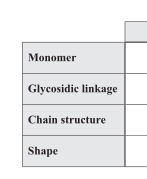
Amylose
Amylopectin
Note: If you make a mistake in the table, cancel it by ruling a single diagonal line through your work and use the additional response space at the back of this question and response book.
c) Determine whether the fermentation of glucose to bioethanol is a redox reaction. Explain your reasoning.
[3 marks]
d) Calculate the atom economy for the fermentation of glucose to bioethanol. Show your working.
[2 marks]
QCAA guide · typeset solution
QCAA sample response and mark allocation
4a) | Enzymes convert starch into glucose via hydrolysis that breaks the glycosidic bond. | • identifies that enzymes break glycosidic bonds in starch to form glucose [1 mark] • explains that enzymes convert starch to glucose via hydrolysis [1 mark] |
4b) | 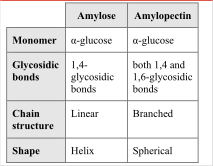 | • describes that the monomer for amylose and amylopectin is α-glucose [1 mark] • describes that amylose contains 1,4-glycosidic bonds and amylopectin contains 1,4 and 1,6- glycosidic bonds [1 mark] • describes that amylose has a straight chain structure and that amylopectin has a branched chain structure [1 mark] • describes that amylose is helical in shape and that amylopectin forms spheres [1 mark] |
4c) | 0 1 2 2 1 2 +1 4 2 + − − + − + − C H O 2(C H O H) 2 C O + 2 6 12 6 2 5 Carbon in glucose is oxidised to CO2. Oxidation number increases from 0 to +4. Carbon in glucose is reduced to C2H5OH. Oxidation number decreases from 0 to –2. | • determines fermentation is a redox reaction [1 mark] • explains carbon in glucose is oxidised to CO2; oxidation number increases from 0 to +4 [1 mark] • explains carbon in glucose is reduced to C2H5OH; oxidation number decreases from 0 to –2 [1 mark] |
4d) | • determines the molar mass of glucose is 180 and molar mass of ethanol is 92 [1 mark] • calculates atom economy [1 mark] |
QCAA sample response and marking criteria reproduced from the official guide.
Compare your working with the guide above.