QUESTION 28 (4 marks)
One structural isomer of C4H9Cl is shown.
CH3
CH3
CH2 CH
Cl
a) Explain why the isomer is a saturated compound.
[1 mark]
b) Identify whether the isomer is a primary or secondary haloalkane.
[1 mark]
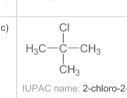
c) Determine the structural formula of another isomer of C4H9Cl that is a tertiary haloalkane, and apply IUPAC rules to name this isomer.
[2 marks]
Note: If you make a mistake, cancel it by ruling a single diagonal line through your work and use the additional response space at the back of this question and response book.
QCAA guide · typeset solution
QCAA sample response and mark allocation
28a) | The isomer is a saturated compound because it contains only single bonds. | • identifies that the compound is saturated because it contains only single bonds [1 mark] |
28b) | Primary haloalkane | • identifies compound is a primary haloalkane [1 mark] |
28c) | IUPAC name: 2-chloro-2-methylpropane | • determines structural formula [1 mark] • determines IUPAC name [1 mark] |
QCAA sample response and marking criteria reproduced from the official guide.
Compare your working with the guide above.