QUESTION 27 (8 marks)
A series of experiments was performed to investigate the optimum reaction conditions to produce biodiesel from seed oils using a two-step process. Step 1: acid esterification using an acid catalyst (H2SO4) Step 2: transesterification using ethanol as a solvent and magnesium oxide as a nanocatalyst The experiments measured the effect of the catalyst concentration, ethanol to seed oil ratio and temperature on biodiesel yield. Temperature was held constant when investigating the effect of catalyst concentration and ethanol to seed oil ratio. The results are shown.
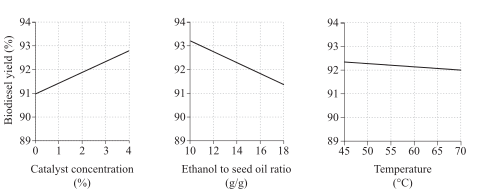
a) Identify the optimal reaction conditions to maximise biodiesel production.
[1 mark]
Catalyst concentration (%):
Ethanol to seed oil ratio (g/g):
Temperature (°C):
b) Explain why both esterification and transesterification reactions are used to optimise biodiesel production.
[3 marks]
c) Determine the effect that catalyst concentration, ethanol to seed oil ratio and temperature have on biodiesel production. Use data to support your reasoning.
[4 marks]
QCAA guide · typeset solution
QCAA sample response and mark allocation
27a) | Catalyst concentration (%): 4 Ethanol to seed oil ratio (g/g): 10:1 Temperature (°C): 45 | • identifies optimal reaction conditions are 4% catalyst concentration, 10:1 ethanol to seed oil ratio and 45 °C [1 mark] |
27b) | In esterification, free fatty acids (FFAs) react with an alcohol to produce esters and water. In transesterification, esters react with an alcohol to produce fatty acid alkyl esters (FAAEs) (biodiesel) and glycerol. A two-step process maximises the conversion of FFAs to biodiesel (FAAE). | • explains that esterification converts free fatty acids to esters [1 mark] • explains that transesterification converts esters to fatty acid alkyl esters [1 mark] • explains that a two-step process maximises the production of biodiesel [1 mark] |
27c) | Increasing the catalyst concentration from 0% to 4% resulted in ~1.8% increase in biodiesel yield from ~91.0% to ~92.8%. Increasing the ethanol–oil ratio from 10:1 g/g to 18:1 g/g resulted in a ~1.9% decrease in biodiesel yield from ~93.2% to ~91.3%. Increasing temperature from 45 °C to 75 °C has minimal effect, decreasing biodiesel yield by ~0.4% from ~92.3% to ~92.0%. | • determines that increasing catalyst concentration increases biodiesel yield [1 mark] • determines that increasing ethanol to seed oil ratio decreases biodiesel yield [1 mark] • determines that increasing temperature results in a slight decrease in biodiesel yield [1 mark] • identifies data from the graphs to support reasoning [1 mark] |
QCAA sample response and marking criteria reproduced from the official guide.
Compare your working with the guide above.