QCEVault

Organic chemistry — Question 14

QCAA 2024, Paper 1 · 1 mark

Q14 · 2024 · Paper 1Unclassified1 mark

QUESTIONS 13–14 Questions 13–14 refer to the reactions below.
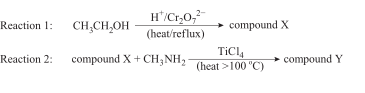
Chemistry question figure

QUESTION 14

Identify compound Y.

(A) CH3CH2CN

(B) CH3CONHCH3

(C) CH3CH2CH2NH2

(D) H2NCH(CH3)COOH

Related questions

  1. Q2 · 2025 QCAA · Paper 1 · 1 mark
    QUESTION 2 Determine the tertiary haloalkane. (A) 2,2-dibromobutane (B) 2,3,3-tribromobutane (C) 2-bromo-2-methylbutane (D) 2-bromo-3-methylbutane
    Organic chemistry
  2. Q4 · 2025 QCAA · Paper 1 · 1 mark
    QUESTION 4 Which type of reaction occurs when an alcohol reacts with a carboxylic acid to form an ester? (A) addition (B) hydrolysis (C) condensation (D) polymerisation
    Organic chemistry
  3. Q12 · 2025 QCAA · Paper 1 · 1 mark
    QUESTION 12 Predict the colour change that occurs when 1-propanol is oxidised to propanoic acid using acidified potassium dichromate (VI). (A) red to yellow (B) orange to green (C) purple to brown (D) pink to colourless
    Organic chemistry
  4. Q24 · 2025 QCAA · Paper 1 · 4 marks
    QUESTION 24  (4 marks) Citronellol is a common ingredient used in the fragrance industry and a component of citronella oil, an insect repellant. Its structure is shown. CH3 CH3 CH3 CH3 CH3 CH3 CH2 CH2 CH2 CH2 CH2 CH2 CH2 CH2 C CH CH CH CH OH OH a) Classify citronellol as saturated or unsaturated. Explain your reasoning. [2 marks] b) Describe a chemical tes…
    Organic chemistry