QCEVault

Polymers and biomolecules — Question 1

QCAA 2023, Paper 2 · 2 marks

Q1 · 2023 · Paper 2Unclassified2 marks

QUESTION 1 (2 marks)

Polylactic acid (PLA) and low-density polyethylene (LDPE) are both used to produce plastic wrapping film.

Plastic

Composition

Density (g/cm3)

Tensile stress (MPa)

Elongation (%)

Degradation rate

PLA

plant-based

1.24

60

6

slow

LDPE

petrochemical-based

0.92

12

148

none

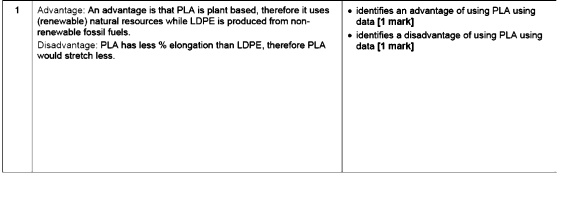
Analyse the data to discuss one advantage and one disadvantage of using PLA rather than LDPE to produce plastic wrapping film.

Advantage:

Disadvantage:

Related questions

  1. Q9 · 2025 QCAA · Paper 1 · 1 mark
    QUESTION 9 Which protein structure contains two or more protein chains bonded together to form subunits? (A) primary (B) secondary (C) tertiary (D) quaternary
    Polymers and biomolecules
  2. Q13 · 2025 QCAA · Paper 1 · 1 mark
    QUESTION 13 Which monosaccharide undergoes a condensation reaction with glucose to form sucrose? (A) galactose (B) fructose (C) glucose (D) maltose
    Polymers and biomolecules
  3. Q4 · 2024 QCAA · Paper 1 · 1 mark
    QUESTION 4 Identify which polymer contains a carbonyl (C= O) group. (A) polyester (B) polyethene (C) polypropene (D) polytetrafluorethene
    Polymers and biomolecules
  4. Q9 · 2024 QCAA · Paper 1 · 1 mark
    QUESTION 9 Polytetrafluorethene (PTFE) has a higher melting point than polypropene (PP) due to the (A) C– F bonds being non-reactive. (B) fluorine atoms forming stable C– F covalent bonds. (C) dispersion forces between closely packed fluorocarbon chains. (D) dipole–dipole interaction between fluorine and carbon atoms within the fluorocarbon chain.
    Polymers and biomolecules