QCEVault

Redox and electrochemistry — Question 24

QCAA 2023, Paper 1 · 5 marks

Q24 · 2023 · Paper 1Unclassified5 marks

QUESTION 24 (5 marks)

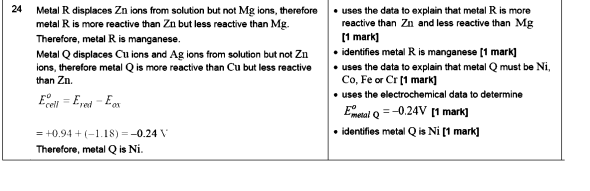
R and Q are unknown transition metals from period 4 of the periodic table. Pieces of R and Q were placed separately into four 0.1 M aqueous solutions. The results are shown.

Unknown metal

0.1 M aqueous solution
Zn(NO3)2
Mg(NO3)2
Cu(NO3)2
AgNO3

R

Coating

No coating

Coating

Coating

Q

No coating

No coating

Coating

Coating

A second experiment was conducted to determine the potential difference produced by electrochemical cells constructed using metals R and Q as the electrodes.

Electrochemical cell

Cathode

Anode

Voltage (V)

1

Q

R

+ 0.94

2

R

Q

− 0.94

Determine the identity of metals R and Q. Explain your reasoning.

Related questions

  1. Q1 · 2025 QCAA · Paper 1 · 1 mark
    QUESTION 1 Which species is produced at the cathode during the electrolysis of an aqueous copper sulfate (CuSO4) solution using platinum electrodes? (A) Cu(s) (B) H2(g) (C) O2(g) (D) SO2(aq)
    Redox and electrochemistry
  2. Q6 · 2025 QCAA · Paper 1 · 1 mark
    QUESTION 6 Determine which statement is true for an electrolytic cell used for electroplating. (A) The redox reaction is spontaneous. (B) The anode is the object to be plated. (C) The cathode is reduced to replenish the metal ions. (D) The electrolyte contains the metal ions that plate the object.
    Redox and electrochemistry
  3. Q10 · 2025 QCAA · Paper 1 · 1 mark
    QUESTION 10 Methane (CH4) reacts with water to produce carbon monoxide (CO) and hydrogen (H2). CH4(g) + H2O(g) → CO(g) + 3H2(g) Determine the reducing agent. (A) H in H2 (B) C in CH4 (C) H in CH4 (D) O in H2O
    Redox and electrochemistry
  4. Q15 · 2025 QCAA · Paper 1 · 1 mark
    QUESTIONS 15–16 Questions 15–16 refer to the galvanic cell shown. Zn(s) | Zn2+(aq) || Ag+(aq) | Ag(s) V Salt bridge Zn Ag QUESTION 15 Calculate the cell potential for the galvanic cell under standard conditions. (A) +0.04 V (B) +0.84 V (C) +1.56 V (D) +2.36 V
    Redox and electrochemistry