QUESTION 1 (8 marks)
The diagram shows a series of different reactions starting with compound A, which has the empirical formula C4H10O.
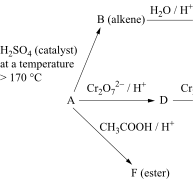
C and A
2− / H+ E (butanoic acid)
a) Identify the class of organic compounds that compound A belongs to.
[1 mark]
b) Compound C is an isomer of compound A. Deduce the structural formulas and IUPAC names of compounds A and C.
[4 marks]
i) Compound A
Note: If you make a mistake in the drawing, cancel it by ruling a single diagonal line through your work and use the additional response space at the back of this question and response book.
IUPAC name:
Note: If you make a mistake in the drawing, cancel it by ruling a single diagonal line through your work and use the additional response at the back of this question and response book.
IUPAC name:
c) Identify whether compounds A and C are structural or geometric isomers.
[1 mark]
d) Deduce the structural formula and IUPAC name for compound F.
[2 marks]
Note: If you make a mistake in the drawing, cancel it by ruling a single diagonal line through your work and use the additional response space at the back of this question and response book.
IUPAC name:
QCAA guide · typeset solution
QCAA sample response and mark allocation
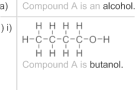
1a) | Compound A is an alcohol. | • identifies the class as alcohol [1 mark] |
1b) i) | Compound A is butanol. | • deduces structural formula for butanol [1 mark] • provides IUPAC name [1 mark] |
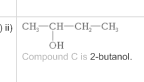
1b) ii) | Compound C is 2-butanol. | • deduces structural formula for 2-butanol [1 mark] • provides IUPAC name [1 mark] |
1c) | Butanol and 2-butanol are structural isomers. | • identifies structural isomers [1 mark] |
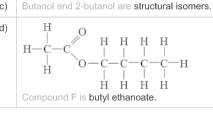
1d) | Compound F is butyl ethanoate. | • provides structural formula for butyl ethanoate [1 mark] • provides IUPAC name as butyl ethanoate [1 mark] |
QCAA sample response and marking criteria reproduced from the official guide.
Compare your working with the guide above.