QUESTION 4 (9 marks)
5.00 × 10⁻⁴ moles of hydrogen gas is mixed with 1.00 × 10⁻³ moles of iodine vapour in a sealed 1.00 L vessel at 455.0 °C. The concentration of hydrogen iodide gas formed at equilibrium is 9.30 × 10⁻⁴ M. The balanced equation for the reaction is shown.
H2(g) + I2(g) ⇌ 2HI(g)
a) Write the equilibrium law expression for the reaction.
[1 mark]
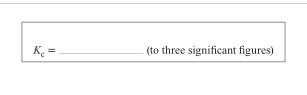
b) Calculate the equilibrium constant (Kc) for the reaction at 455.0 °C. Show your working.
[5 marks]
c) Predict the effect that adding a catalyst would have on the reaction rates, position of the equilibrium and value of Kc.
[3 marks]
QCAA guide · typeset solution
QCAA sample response and mark allocation
4a) | Kc=[HI]2[H2]×[I2] | • provides Kc= [HI]2[H2]×[I2][1 mark] | |
4b) | Change in [H2]= [I2]= 9.30×10⁻⁴ mol L×1 mol H22 mol HI= 4.65 × 10⁻⁴ M [H2]eq = 5.00 × 10⁻⁴−4.65 × 10−4 = 3.50 × 10⁻⁵ M [I2]eq = 1.0 × 10⁻³−4.65 × 10−4 = 5.35 × 10⁻⁴ M Kc =(9.30×10⁻⁴)23.50×10−5 ×5.35×10−4 = 46.2 Kc= 46.2 (to three significant figures) | • correctly determines change in [H2] = [I2] = 4.65 × 10⁻⁴ [1 mark] • determines [H2]eq = 3.50 × 10⁻⁵ [1 mark] • determines [I2]eq = 5.35 × 10⁻⁴ [1 mark] • shows substitution correctly performed [1 mark] • determines Kc = 46.2 [1 mark] | Allow FT error for [H2]eq. Allow FT error for [I2]eq. Allow FT error from Question 1a). Do not penalise for incorrect decimal places/significant figures. |
4c) | A catalyst will speed up both the forward and the reverse reactions. Therefore, the position of the equilibrium will not change. Therefore, there will be no change in the value of the equilibrium constant, Kc. | • identifies that a catalyst speeds up both the forward and reverse reactions [1 mark] • identifies that a catalyst has no effect on the position of the equilibrium [1 mark] • determines that a catalyst has no effect on the Kc value [1 mark] |



QCAA sample response and marking criteria reproduced from the official guide.
Compare your working with the guide above.