QUESTION 3 (11 marks)
Four colourless liquids, A, B, C and D, are known to be butane, 1-butene, 2-butanol and 1-propanol. Reactions are carried out to identify the liquids. The results are shown.
Test 1 | A | B | C | D |
Bromine (Br2) water | No reaction | No reaction | No reaction | Decolourised |

Test 2 | A | B | C |
Excess acidified potassium manganate(VII) (KMnO4) solution, heated gently | Decolourised, Compound X formed | Decolourised, Compound Y formed | No reaction |
Test 3 | Compound X | Compound Y |
Ethanol and concentrated sulfuric acid solution, heated gently and refluxed | Fruity smell produced, Compound Z formed | No apparent reaction |
a) Identify Compound D. Explain your reasoning.
[2 marks]
b) Write a balanced equation to describe the decolourisation of bromine (Br2) water by Compound D. Apply IUPAC rules to name the product formed.
[2 marks]
IUPAC name:
c) Identify Compound C. Explain your reasoning.
[3 marks]
d) Draw the structural formula of Compound Y.
[1 mark]
Note: If you make a mistake in the drawing, cancel it by ruling a single diagonal line through your work and use the additional response space on page 17 of this question and response book.
e) Identify Compound B.
[1 mark]
f) Draw the structural formula of Compound Z.
[1 mark]
Note: If you make a mistake in the drawing, cancel it by ruling a single diagonal line through your work and use the additional response space on page 17 of this question and response book.
g) Apply IUPAC rules to name Compound Z.
[1 mark]
IUPAC name:
QCAA guide · typeset solution
QCAA sample response and mark allocation
3a) | Compound D is 1-butene. Undergoes addition reaction with Br2(aq). | • identifies Compound D as 1-butene [1 mark] • indicates that Compound D undergoes addition [1 mark] | For 1-butene, accept but-1-ene. |
3b) | CH2CHCH2CH3 + Br2→CH2(Br)CH(Br)CH2CH3IUPAC name: 1,2-dibromobutane | • indicates balanced equation with the correct structural formula for reactants and products [1 mark] • correctly names 1,2-dibromobutane [1 mark] | Allow FT error from equation. |
3c) | Compound C is butane. It can’t be oxidised by potassium manganate(VII) or undergo an addition reaction with bromine water. Therefore, Compound C is unreactive because it’s saturated. | • identifies Compound C as butane [1 mark] • identifies that Compound C cannot be oxidised [1 mark] • concludes that Compound C is unreactive and saturated [1 mark] | For saturated, accept contains only single bonds. Acceptable response is to identify that Compound C cannot undergo an addition reaction. |
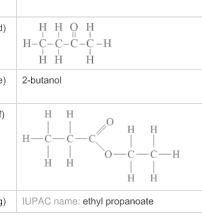
3d) | • provides correct structural formula for butanone for Compound Y [1 mark] | Acceptable response is Compound Y = CH3COCH2CH3 | |
3e) | 2-butanol | • identifies Compound B as 2-butanol [1 mark] | For 2-butanol, accept butan-2-ol. |
3f) | • provides correct structural formula for ethyl propanoate for Compound Z [1 mark] | Acceptable response is Compound Z = CH3CH2COOCH2CH3 | |
3g) | IUPAC name: ethyl propanoate | • correctly names ethyl propanoate [1 mark] |


QCAA sample response and marking criteria reproduced from the official guide.
Compare your working with the guide above.