QUESTION 2 (10 marks)
Polypropene (PP) is a polymer formed from propene. Polyethylene terephthalate (PET) is a polymer formed from monomers of carboxylic acid and alcohol. A section of the PET polymer is shown.
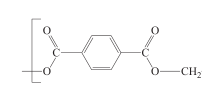
CH2 n
a) Draw the structural formulas of the monomers used to form PET.
[2 marks]
i) Carboxylic acid monomer
Note: If you make a mistake in the drawing, cancel it by ruling a single diagonal line through your work and use the additional response space on page 16 of this question and response book.
b) Determine the type of polymerisation used to form PET.
[1 mark]
c) Identify the functional group formed by the reaction of the monomers in PET.
[1 mark]
d) Determine the type of polymerisation used to form PP.
[1 mark]
e) Explain how the position of the methyl group on the polymer chain affects the strength of isotactic PP, relative to syntactic PP.
[5 marks]
QCAA guide · typeset solution
QCAA sample response and mark allocation
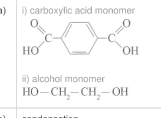
2a) | i) carboxylic acid monomer ii) alcohol monomer | • provides the correct structural formula for - benzene-1,4-dicarboxylic acid (terephthalic acid) [1 mark] - ethane-1,2-diol (ethylene glycol) [1 mark] | |
2b) | condensation | • determines polymerisation as condensation [1 mark] | For condensation, accept: - elimination - esterification. |
2c) | Ester | • identifies ester as the functional group [1 mark] | Also accept: - RCOOR1- carboalkoxy. |
2d) | addition | • determines polymerisation as addition [1 mark] |

2e) | Structural features Isotactic and syntactic — both have regular arrangement methyl groups. Syntactic has methyl groups on the opposite side of the polymer chain, while isotactic has methyl groups on the same side of the chain. Properties Isotactic — chains can pack closer together, resulting in greater intermolecular forces. Isotactic PP is therefore stronger than syntactic PP. | • identifies regular arrangement methyl groups [1 mark] • identifies methyl groups on the opposite side of the chain for syntactic and same side of the chain for isotactic PP [1 mark] • indicates that isotactic chains can pack closer together [1 mark] • indicates increased intermolecular forces for isotactic PP [1 mark] • indicates increased strength for isotactic PP [1 mark] | For intermolecular forces, accept dispersion forces. |
QCAA sample response and marking criteria reproduced from the official guide.
Compare your working with the guide above.