QUESTION 26 (5 marks)
The graph represents changes in concentration over time for three gaseous molecules (X2, Y2 and XY) in a closed system at constant temperature and pressure.
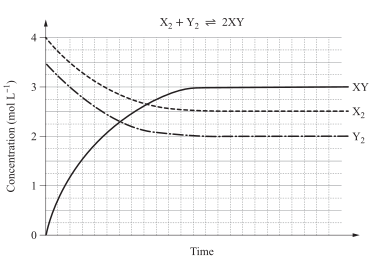
a) Identify whether XY is the reactant or the product.
[1 mark]
b) Calculate the equilibrium constant (Kc) value.
[2 marks]
c) Determine whether the position of equilibrium favours the reactants or products. Explain your reasoning.
[2 marks]
QCAA guide · typeset solution
QCAA sample response and mark allocation
26a) | XY is the product. | • identifies XY as the product [1 mark] | |
26b) | Kc =[XY]2[X][Y]=322×2.5= 1.8 (to two significant figures) | • indicates correct substitution [1 mark]• determines Kc = 1.8 [1 mark] | Allow FT error for Kc. Do not penalise for incorrect decimal places/significant figures. |
26c) | Kc > 1.Therefore, equilibrium favours the products. | • identifies Kc > 1 [1 mark] • concludes that equilibrium favours products [1 mark] | Allow FT error for Kc. |



QCAA sample response and marking criteria reproduced from the official guide.
Compare your working with the guide above.