QUESTION 24 (6 marks)
The cell diagram represents a voltaic cell at standard conditions. The copper solution is blue because of the presence of Cu2+(aq) ions. The acidified permanganate solution is purple because of the presence of MnO4 –(aq) ions.
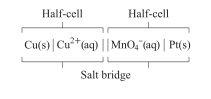
a) Predict which direction the electrons will flow in the voltaic cell by comparing the relative strength of the oxidising agents. Explain your reasoning.
[3 marks]
b) Determine the standard reduction potential, E◦, for the cell.
[1 mark]
c) Predict two qualitative observations associated with the flow of electrons and the movement of ions in the voltaic cell.
[2 marks]
QCAA guide · typeset solution
QCAA sample response and mark allocation
24a) | MnO4 − (aq) (+1.51 V) is a stronger oxidising agent than Cu2+(aq) (+0.34 V) because it has a more positive standard potential. MnO4 − (aq) is preferentially reduced and gains electrons from Cu(s), which is oxidised. Therefore, electrons flow from Cu electrode to Pt electrode. | • correctly identifies MnO4 − as the stronger oxidising agent [1 mark] • correctly identifies that MnO4 − gains electrons [1 mark] • determines that electrons flow from Cu to Pt electrode [1 mark] | Acceptable responses are: - MnO4 − is reduced - Cu is oxidised - Cu loses electrons. Acceptable responses are that electrons flow from: - Cu electrode to Pt electrode - Cu(s) to MnO4 − (aq). |
24b) | • determines that the standard reduction potential is 1.17 [1 mark] | Do not penalise for incorrect decimal places/significant figures. |
24c) | Cu2+(aq) concentration will increase and the solution will become darker. MnO4 –(aq) concentration will decrease and the solution will become lighter. | • predicts that the Cu2+(aq) solution will become darker [1 mark] • predicts that the MnO4 –(aq) solution will become lighter [1 mark] | Acceptable responses are: - Cu electrode will become smaller - Cu2+ solution will become darker - MnO4 – solution will become lighter - MnO4 – solution will become colourless. Allow FT error from 24a). |
QCAA sample response and marking criteria reproduced from the official guide.
Compare your working with the guide above.