QUESTION 23 (5 marks)
Aspartame is a methyl ester of a dipeptide that hydrolyses to form methanol and two amino acids. The structure of aspartame is shown.
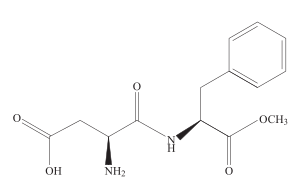
a) Identify the two amino acids that form aspartame.
[1 mark]
A hydrolysed sample of aspartame was analysed with silica thin layer chromatography (TLC), using a mixture of butanol and ethanoic acid as the solvent. The TLC plate was then reacted with ninhydrin to produce spots.
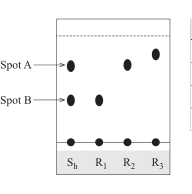
Key
Sh = hydrolysed aspartame sample
R1 = reference amino acid 1
R2 = reference amino acid 2
R3 = isoleucine
b) Determine which amino acid in aspartame corresponds to Spot A. Explain your reasoning.
[3 marks]
c) Explain why the reference amino acids are included on the TLC plate.
[1 mark]
QCAA guide · typeset solution
QCAA sample response and mark allocation
23a) | aspartic acid and phenylalanine | • correctly identifies aspartic acid and phenylalanine [1 mark] | For aspartic acid, accept Asp. For phenylalanine, accept Phe. Accept correctly drawn diagrams. |
23b) | Isoleucine is a non-polar amino acid. The distance travelled by Spot A is similar to the distance travelled by isoleucine; therefore, Spot A is also non-polar. Spot A is phenylalanine because it is a non-polar amino acid. | • indicates that isoleucine is non-polar [1 mark] • indicates that Spot A is non-polar and travels a similar distance to isoleucine [1 mark] • determines that Spot A is phenylalanine [1 mark] | Acceptable response indicates Spot A has a similar Rf value (distance travelled) as isoleucine and is therefore non-polar. |
23c) | To allow the distance travelled by the separated amino acids to be compared to control amino acids. | • indicates that separated amino acids can be compared to control amino acids [1 mark] | Acceptable response indicates Rf value for separated amino acids can be compared to Rf values for control amino acids. |
QCAA sample response and marking criteria reproduced from the official guide.
Compare your working with the guide above.