QUESTION 94 (8 marks)
A hypothetical reserve contains dingoes, browsing wallabies and young trees. After dingo numbers recover, wallaby abundance falls and tree growth increases. The carbon table includes all photosynthetic uptake and biotic respiratory return for the measured plots; assume other carbon exchanges are negligible.
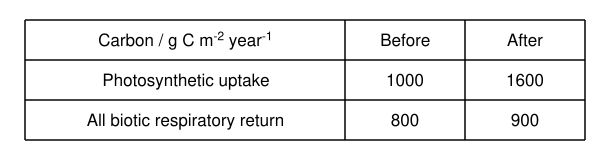
a) Explain a trophic-cascade mechanism consistent with these observations. [3 marks]
b) Calculate net carbon uptake before and after dingo recovery and the change between them. [3 marks]
c) Explain why net carbon uptake is not the same as gross photosynthetic uptake. [2 marks]
Practice marking scheme
Answer
a) More dingoes increase wallaby predation; fewer wallabies reduce browsing; more tree growth follows. b) 200 to 700 g C m⁻² year⁻¹, an increase of 500. c) Respiration returns some fixed carbon to the atmosphere.
Working
Dingoes may suppress wallabies, releasing tree seedlings from browsing. Net biotic carbon uptake is photosynthetic fixation minus all measured biotic respiration. Before: 1000 − 800 = 200; after: 1600 − 900 = 700; increase = 500 g C m⁻² year⁻¹. Gross fixation counts all photosynthetic input, whereas net accumulation accounts for carbon returned during respiration. The mechanistic explanation is consistent with the observations, without proving that no other changes contributed.
Marking criteria
- Links dingo recovery to stronger wallaby predation. [1 mark]
- Links fewer wallabies to reduced browsing. [1 mark]
- Links reduced browsing to increased young-tree growth. [1 mark]
- Calculates pre-recovery net uptake 200. [1 mark]
- Calculates post-recovery net uptake 700. [1 mark]
- Calculates the increase 500. [1 mark]
- Explains gross photosynthetic uptake. [1 mark]
- Explains subtraction of respiratory carbon return to obtain net uptake. [1 mark]
Practice question aligned to the current QCAA syllabus; review the worked solution and marking criteria.
View the QCAA syllabusCompare your working with the guide above.