QUESTION 93 (9 marks)
A grassland fire leaves soil and a seed bank intact. As shrubs establish, light reaching the ground decreases. In one diploid annual herb, allele S increases shade tolerance. The table shows complete genotype counts before the fire and after several generations of succession. Assume no immigration or new mutations during this period.
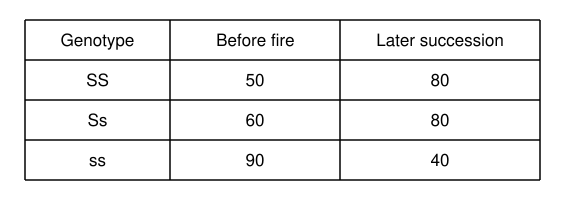
a) Identify the succession type and justify your choice. [2 marks]
b) Calculate S frequency at both times and its change. [3 marks]
c) Explain how the changing environment could cause the observed allele-frequency trend. [3 marks]
d) Explain why it would be incorrect to say that each individual herb evolved greater shade tolerance. [1 marks]
Practice marking scheme
Answer
a) Secondary succession, because soil remains. b) 0.40 to 0.60; +0.20. c) Increasing shade can favour S carriers through differential survival/reproduction. d) Evolution describes population allele-frequency change across generations.
Working
Before: . Later: . Soil retention identifies secondary succession. Shrub growth changes light conditions, creating a selection pressure. Herbs with heritable shade tolerance may survive and reproduce more successfully, passing S to more offspring and increasing its population frequency. Individuals can grow or alter expression, but they do not change the population’s allele frequency by evolving during their lifetime.
Marking criteria
- Identifies secondary succession. [1 mark]
- Justifies with retained soil/seed bank. [1 mark]
- Calculates initial S frequency 0.40. [1 mark]
- Calculates later S frequency 0.60. [1 mark]
- Calculates increase of 0.20. [1 mark]
- Links shrub establishment to decreased light and a selection pressure. [1 mark]
- Links S to differential survival/reproduction under shade. [1 mark]
- Links inheritance and reproduction to increasing S frequency. [1 mark]
- Distinguishes individual change from population evolution across generations. [1 mark]
Practice question aligned to the current QCAA syllabus; review the worked solution and marking criteria.
View the QCAA syllabusCompare your working with the guide above.