QUESTION 47 (6 marks)
A sealed terrarium contains plants, small herbivores and decomposers. Its measured carbon flows are shown. Assume the table includes all transfers between atmospheric CO₂ and living organisms during this day.
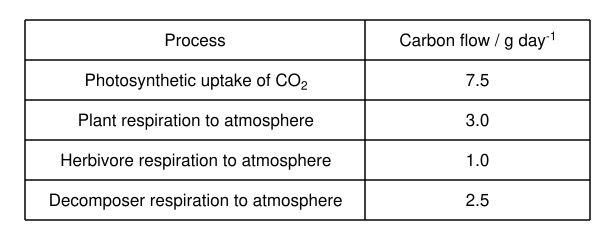
a) Determine the net change in atmospheric carbon, in grams, over the day. [2 marks]
b) Describe how photosynthesis transforms carbon and how feeding transfers carbon. [2 marks]
c) Explain why carbon can cycle through this terrarium while useful energy still needs an external input. [2 marks]
Practice marking scheme
Answer
a) Atmospheric carbon decreases by 1.0 g. b) CO₂ carbon is incorporated into organic molecules; feeding transfers organic carbon between organisms. c) Matter cycles, but energy is dissipated as heat.
Working
Respiration returns 3.0 + 1.0 + 2.5 = 6.5 g of carbon to the atmosphere. Photosynthesis removes 7.5 g, so atmospheric carbon changes by −1.0 g. Photosynthesis builds organic molecules using inorganic CO₂; feeding moves this organic carbon through consumers. Carbon atoms can be recycled, whereas energy transfers include heat losses, so the terrarium requires continuing light input.
Marking criteria
- Totals respiratory carbon release as 6.5 g. [1 mark]
- Calculates net atmospheric change −1.0 g. [1 mark]
- Describes inorganic CO₂ carbon becoming organic carbon during photosynthesis. [1 mark]
- Describes feeding as transfer of organic carbon. [1 mark]
- States that matter can be recycled. [1 mark]
- Links heat losses to the need for external energy input. [1 mark]
Practice question aligned to the current QCAA syllabus; review the worked solution and marking criteria.
View the QCAA syllabusCompare your working with the guide above.