QCEVault

Functioning ecosystems and succession — Question 26

QCAA 2023, Paper 1 · 3 marks

Q26 · 2023 · Paper 1Unclassified3 marks

QUESTION 26 (3 marks)

Wedge-tailed eagles are large birds that reside in tall trees, where they build nests for their young. They often feed on ground-dwelling herbivores such as kangaroos and rabbits.

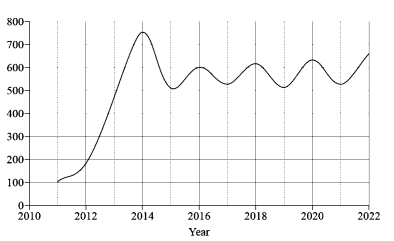
The graph shows the number of wedge-tailed eagles observed in an ecosystem over time.
Biology question figure

Number of eagles

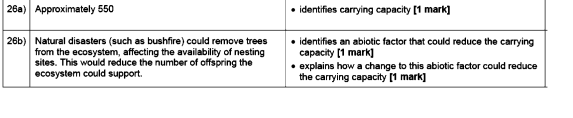
a) Determine the carrying capacity of wedge-tailed eagles in this ecosystem. [1 mark]

b) Explain how a change to one abiotic factor could reduce the carrying capacity. [2 marks]

Related questions

  1. Q2 · 2025 QCAA · Paper 1 · 1 mark
    QUESTION 2 The diagram shows energy flow through an ecosystem in kJ m−2 year−1. Shaded boxes represent gross productivity. Respiration and heat 50 000 7800 Primary consumers Sunlight Producers 7 200 000 87 000 22 600 5060 Decomposers Calculate the percentage of solar energy available to primary consumers. (A) 0.1% (B) 0.2% (C) 0.4% (D) 0.5%
    Functioning ecosystems and succession
  2. Q7 · 2025 QCAA · Paper 1 · 1 mark
    QUESTION 7 Which process is involved in both carbon and water cycling? (A) respiration (B) evaporation (C) transpiration (D) precipitation
    Functioning ecosystems and succession
  3. Q20 · 2025 QCAA · Paper 1 · 1 mark
    QUESTION 20 The graph shows the relative impact of habitat destruction, overexploitation, pollution and other human activities on four taxonomic groups. Reptiles and amphibians Land mammals Birds Fish 0 10 20 30 40 50 60 70 80 90 100 Relative impact (%) Key Habitat destruction Overexploitation Pollution Other Which activity has the greatest impact on terrest…
    Functioning ecosystems and succession
  4. Q22 · 2025 QCAA · Paper 1 · 5 marks
    QUESTION 22  (5 marks) a) Compare the role of pioneer species in primary and secondary succession. [3 marks] Similarity:
    Difference:
    Significance:
    b) Describe two ways climax communities differ from pioneer communities. [2 marks]
    Functioning ecosystems and succession