Q11 · 2020 · Technology-freeSimple familiar7 marks
QUESTION 11 (7 marks)
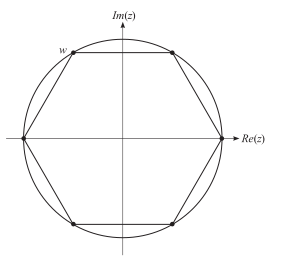
The vertices of a regular hexagon are positioned on the circumference of a unit circle as shown on the Argand plane.
Consider the complex number , as shown on the plane.
a)[1 mark]
Determine , expressing your answer in the form .
b)[2 marks]
Convert into Cartesian form.
c)[1 mark]
Each vertex of the hexagon is a solution of an equation of the form , where . State the value of .
d)[1 mark]
State the value of .
e)[2 marks]
Verify that satisfies the equation using the results from 11c) and 11d).
WORKED SOLUTION
7 marksQCAA guide · typeset solution
ANSWER
Worked solution
a) and , so .
b) .
c) .
d) .
e) , so the required result is verified.
correctly expresses in form
converts into form
uses exact values for and
correctly states the value of
correctly states the value of
uses De Moivre’s theorem in the calculation of for the value of
verifies the result by showing that the result of the calculation is the value of
One QCAA sample method typeset for web; criterion wording is adapted from the official marking guide.
View the full QCAA marking guideHow many marks did you earn?
Compare your working with the guide above.