Q264 · Practice questionTechnology-freeComplex familiar6 marks
QUESTION 264 (6 marks)
Consider and .
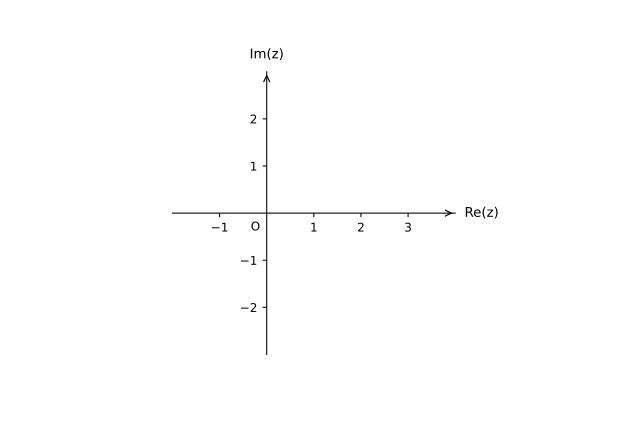
a)[2 marks]
Sketch both loci on the blank Argand axes, labelling the circle centre and radius.
b)[2 marks]
Determine the intersection points exactly.
c)[2 marks]
Construct the monic quadratic with these two complex roots. Expand your answer.
ANSWER
(a) A circle centred at with radius 2, and the horizontal line .
(b) or .
(c) .
(a) Let . The equations are and . Both are complete loci, with solid boundaries.
(b) Substitute into the circle: , so .
(c) The root sum is and product is . Thus . Its coefficients are complex; conjugate-root pairing is not applicable.
Equivalent justified methods accepted; respect any requested proof method.
Exact values unless specified. Sketches assessed by mathematical features, not artistic quality.
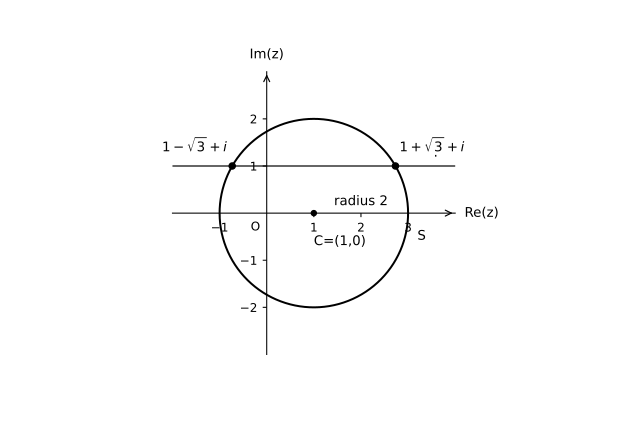
Part a: Draw the correct labelled circle.
Part a: Draw the horizontal line .
Part b: Substitute the line into the circle.
Part b: Find and express both intersections in complex form.
Part c: Find the root sum and product.
Part c: Write the correctly expanded quadratic.