QCEVault

Projectile motion — Question 27

QCAA 2024, Paper 1 · 4 marks

Q27 · 2024 · Paper 1Complex familiar4 marks

QUESTION 27 (4 marks)

On another planet, an object was projected upwards from an initial height and took 0.71 s0.71\,\mathrm{s} to land.
The relationship between vertical displacement and time is sy=−5.18t2+3.5ts_y=-5.18t^2+3.5t. Determine the horizontal displacement of the object when it lands.
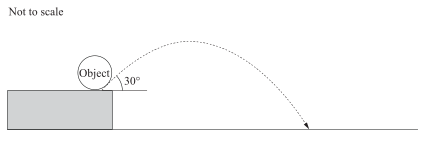
Official QCAA diagram or graph for Physics 2024 Paper 1 Question 27.
Question linkOriginal paper

Related questions

  1. Q13 · 2025 QCAA · Paper 1 · 1 mark
    Questions 13–14 refer to the following scenario. A projectile was launched with a velocity of 31 m s−131\,\mathrm{m\,s^{-1}} at an angle of 28∘28^\circ to the horizontal.
    Calculate the horizontal component of the launch velocity of the projectile in the forward direction.
    Projectile motion
  2. Q14 · 2025 QCAA · Paper 1 · 1 mark
    Questions 13–14 refer to the following scenario. A projectile was launched with a velocity of 31 m s−131\,\mathrm{m\,s^{-1}} at an angle of 28∘28^\circ to the horizontal.
    Calculate the maximum height the projectile reached above its starting point.
    Projectile motion
  3. Q25 · 2025 QCAA · Paper 1 · 11 marks
    An experiment was conducted by launching a ball with an initial velocity of 3.0 m s−13.0\,\text{m\,s}^{-1} at varying angles from the horizontal from a height of 1.0 m above the ground. The horizontal displacement was recorded to produce the graph shown.
    Projectile motion
  4. Q12 · 2024 QCAA · Paper 1 · 1 mark
    The horizontal displacement of an object experiencing projectile motion was measured and recorded against the cosine of the launch angle (i.e. the angle up from the horizontal). The initial velocity was kept constant.
    What launch angle would cause the object to land 1.0 m1.0\,\mathrm{m} from its starting position?
    Projectile motion