Q6 · 2023 · Paper 2Complex familiar10 marks
QUESTION 6 (10 marks)
A ball is thrown with an initial velocity of into a bucket as shown.
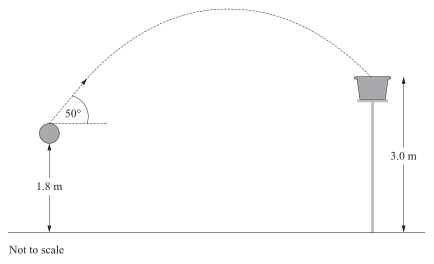
a)[4 marks]
Calculate the time taken for the ball to reach its maximum height. Show your working. Give your answer to two significant figures.
b)[6 marks]
Calculate the magnitude of the ball’s final velocity when it enters the bucket. Show your working. Give your answer to two significant figures.
Sample response The
u, =8.0sin50=6.13 ms* ere
ur
vy = gttu, • ce
0=-9.87+6.13 “hh
t=0.63s • ce
4
Time = 0.63 s (to two significant figures) t
Method 1: Vector solution ere
Impact velocity equal to the vector sum of V, and vy re
vy = 2gs, +u,” -
> ° ce
=2x-9.8x1.2+6.13 .
=14.1 -
, = a ° pr
vy, =3.7ms it
v, =u, =8.0cos50=5.1ms" ode
ne
- y 3.8
~~ |
Sample response The
Method 2: Energy solution ere
KE; = KE; + GPE :
1 1 ° de
=mu? ==mv? + mgh ° pr
2 2
1 1, i
5X8 =3” +9.8xX 1.2 ° de
v? = 40.48
v=636ms*
Final velocity = 6.4 m s“ (to two significant figures)
he response:
e recognises the scenario relates to an object
undergoing projectile motion [1 mark]
• calculates the initial vertical velocity [1 mark]
• provides appropriate mathematical reasoning
[1 mark]
• calculates time taken to reach maximum height
[1 mark]
e recognises the scenario relates to the
relationship between initial and final velocities
— vertically [1 mark]
— horizontally [1 mark]
e calculates final
— vertical velocity [1 mark]
— horizontal velocity [1 mark]
• provides appropriate mathematical reasoning
[1 mark]
e determines the final velocity [1 mark]
he response:
e recognises the scenario relates to
— conservation of energy [1 mark]
— kinetic energy [1 mark]
- gravitational potential energy [1 mark]
e demonstrates correct substitution [1 mark]
• provides appropriate mathematical reasoning
[1 mark]
e determines the final velocity [1 mark]