Q7 · 2021 · Paper 2Simple familiar6 marks
QUESTION 7 (6 marks)
An object on a planet is launched horizontally from a cliff. Its vertical displacement is measured over 6 seconds. The graph shows the object’s vertical displacement with respect to time squared.
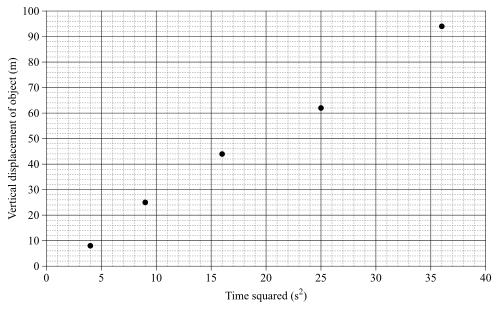
a)[3 marks]
Determine the mathematical relationship between vertical displacement (s) and time (t).
b)[3 marks]
Calculate the acceleration due to gravity on the planet.
The mathematical proportionality is
𝑠 ∝ 𝑡2
intercept = 0
gradient = 𝑦2 −𝑦1
𝑥2 −𝑥1
gradient = 94 −0
36 −0
gradient = 2.6
𝑠= 2.6𝑡2
𝑠= 𝑢𝑡+ 1
2 𝑎𝑡2
Therefore 2.6𝑡2 =
1
2 𝑎𝑡2
This means that
1
2 𝑎= 2.6
𝑎= 2 × 2.6
𝑎= 5.2 m s−2
Acceleration = 5.2 m s–2 (to 2 significant figures)
• identifies the y-intercept [1 mark]
• determines the gradient of the graph [1 mark]
• identifies a mathematical relationship [1 mark]
• recognises the gradient can be used to find
acceleration due to gravity [1 mark]
• provides appropriate mathematical reasoning
[1 mark]
• calculates the acceleration due to gravity [1 mark]