Q23 · 2021 · Paper 1Complex familiar5 marks
QUESTION 23 (5 marks)
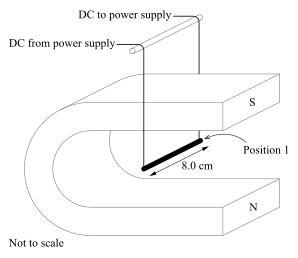
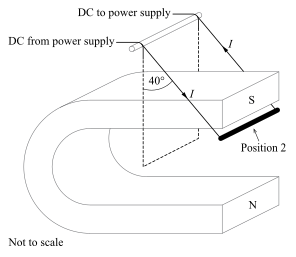
The diagram shows a metal rod with a mass of 10.0 g and a length of 8.0 cm suspended in a uniform magnetic field of 0.50 T. There is no electric current through the metal rod when it is in Position 1.
When a current () is passed through the metal rod it moves to Position 2, with an angle of to the vertical.
Determine the magnitude of the current required to move the metal rod into Position 2.
WORKED SOLUTION
5 marksQCAA guide · typeset solution
ANSWER
See worked solution below.
Worked solution
There are three forces acting on the wire and they are
balanced, forming a vector triangle.
From the vector triangle:
tan 𝜃= 𝐹𝑚𝑎𝑔
𝐹𝑔
Therefore 𝐹𝑚𝑎𝑔= 𝐹𝑔tan 𝜃
Therefore 𝐹𝑚𝑎𝑔= 𝑚𝑔tan 40o
Sub in magnetic force formula on the left-hand side:
𝐵𝐼𝐿sin 𝜃= 𝑚𝑔tan 40o
The magnetic field is at right angles to the current:
𝐵𝐼𝐿sin 90o = 𝑚𝑔tan 40o
Since sin 90° = 1, rearranging
𝐼= 𝑚𝑔tan 40o
𝐵𝐿
𝐼= (0.0100)(9.8) tan 40o
(0.50)(0.080)
𝐼= 2.055 794 …
Current = 2.1 A (to 1 decimal place)
• identifies the forces acting on the wire in the
magnetic field [1 mark]
• recognises that the force of gravity and the force
of the magnetic field can be added to determine
tension [1 mark]
• identifies an equation for the relationship
between Fg and Fmag [1 mark]
• provides appropriate mathematical reasoning
[1 mark]
• determines the magnitude of the current
[1 mark]
One QCAA sample method typeset for web; criterion wording is adapted from the official marking guide.
How many marks did you earn?
Compare your working with the guide above.