Q9 · 2020 · Paper 2Complex unfamiliar5 marks
QUESTION 9 (5 marks)
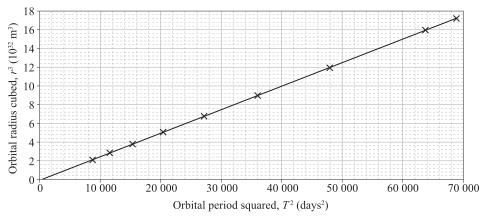
Nine planets orbit the same star. The orbital radius and orbital period of each planet was measured. The graph shows the cube of the orbital radius of each planet, , compared to its orbital period squared, .
Determine the mass of the star. Show your working.
WORKED SOLUTION
5 marksQCAA guide · typeset solution
ANSWER
See worked solution below.
Worked solution
The gradient of the graph can be used to find
𝐺𝐺𝐺𝐺
4𝜋𝜋2.
The gradient of the graph can be found using the
following two points: (0,0) and (40 000, 10).
First, the x values will be converted to seconds2
(0,0) and (2.985984 x10¹⁴, 10 x 1032).
The gradient = 3.37 x 10¹⁸
Let the gradient be represented by the pronumeral V.
𝑉𝑉= 𝐺𝐺𝐺𝐺
4𝜋𝜋2
𝑀𝑀= 𝑉𝑉4𝜋𝜋2
𝐺𝐺
Mass = 2.0 × 1030 kg (to 1 decimal place)
• indicates an understanding that the gradient
represents
𝐺𝐺𝐺𝐺
4𝜋𝜋2 [1 mark]
• provides pertinent mathematical operation/s
correctly performed to convert days2 into seconds2
[1 mark]
• arrives at a value for the gradient [1 mark]
• provides pertinent mathematical operation/s
correctly performed using the gradient [1 mark]
• determines the mass [1 mark]
One QCAA sample method typeset for web; criterion wording is adapted from the official marking guide.
How many marks did you earn?
Compare your working with the guide above.