Q6 · 2020 · Paper 2Complex unfamiliar4 marks
QUESTION 6 (4 marks)
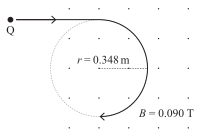
The diagram shows a particle, Q, entering a uniform magnetic field of . The particle has a speed of . Once in the magnetic field, the particle moves in a circular path as shown.
It is suspected that Q is one of the particles listed in the table.
| Particle number | Charge, (C) | Mass, (kg) |
|---|---|---|
| 1 | ||
| 2 | ||
| 3 | ||
| 4 | ||
| 5 |
Determine which particle Q is most likely to be.
WORKED SOLUTION
4 marksQCAA guide · typeset solution
ANSWER
See worked solution below.
Worked solution
Using the right-hand rule and the motion of the particle, it
must be a positive particle.
The particle moves in a circle due to the magnetic force.
𝐹𝐹𝑚𝑚𝑚𝑚𝑚𝑚= 𝐹𝐹𝑐𝑐𝑐𝑐𝑐𝑐𝑐𝑐𝑐𝑐𝑐𝑐𝑐𝑐𝑐𝑐
𝑞𝑞𝑞𝑞𝑞𝑞sin 𝜃𝜃= 𝑚𝑚𝑣𝑣2
𝑟𝑟
Particle enters perpendicularly, therefore
sin 𝜃𝜃= sin 90° = 1
𝑞𝑞𝑞𝑞𝑞𝑞= 𝑚𝑚𝑣𝑣2
𝑟𝑟
𝑚𝑚= 𝑞𝑞𝑞𝑞𝑞𝑞
𝑣𝑣
𝑚𝑚=
(1.60 × 10⁻¹⁹)(0.090)(3.48 × 10⁻¹)
1.50 × 10⁶
𝑚𝑚= 3.34 × 10⁻²⁷kg
Therefore, Particle Q must be Particle 4.
• indicates an understanding of the physical
scenario in relation to the force on a positive
charge in a magnetic field, and centripetal force [1
mark]
• provides pertinent mathematical operations
correctly performed [1 mark]
• determines the mass [1 mark]
• identifies the correct particle using the mass and
the charge of the particle [1 mark]
One QCAA sample method typeset for web; criterion wording is adapted from the official marking guide.
How many marks did you earn?
Compare your working with the guide above.