Further applications of differentiation — Question 237
Original QCE Vault practice · 6 marks
Q237 · Practice questionTechnology-activeComplex unfamiliar6 marks
QUESTION 237 (6 marks)
A closed cylindrical can must hold 750cm3. Let r be its radius. 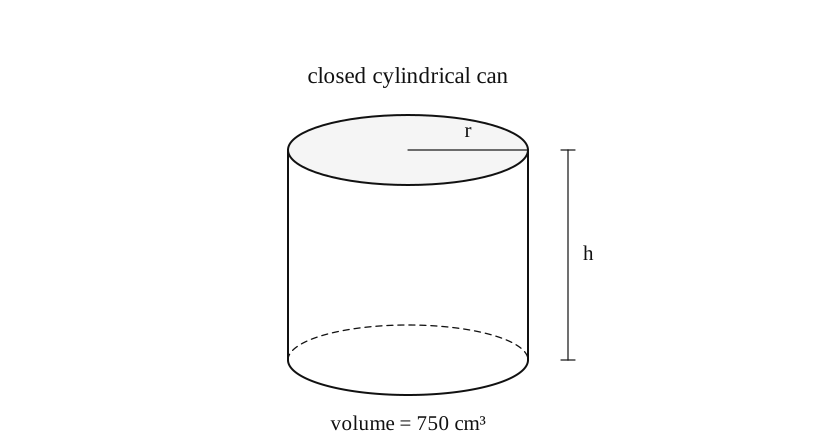
a)Show that its surface area can be written S(r)=2πr2+r1500. b)Find the radius that minimises surface area.
c)Find the corresponding height and minimum surface area.
WORKED SOLUTION
Practice marking scheme
6 marksANSWERh=πr2750=9.85cm (indeed h=2r). Smin≈457.0cm2. Worked solution
Part (a): Volume πr2h=750 gives h=πr2750. S=2πr2+2πrh=2πr2+r1500. Part (b): S′=4πr−r21500=0→r3=π375→r=(π375)31=4.92cm. Part (c): h=πr2750=9.85cm (indeed h=2r). Smin≈457.0cm2. Part (a): completes the requested reasoning and obtains a correct result.
Part (b): completes the requested reasoning and obtains a correct result.
Part (c): completes the requested reasoning and obtains a correct result.
Practice question aligned to the current QCAA syllabus; review the worked solution and marking criteria.
View the QCAA syllabusHow many marks did you earn?Compare your working with the guide above.