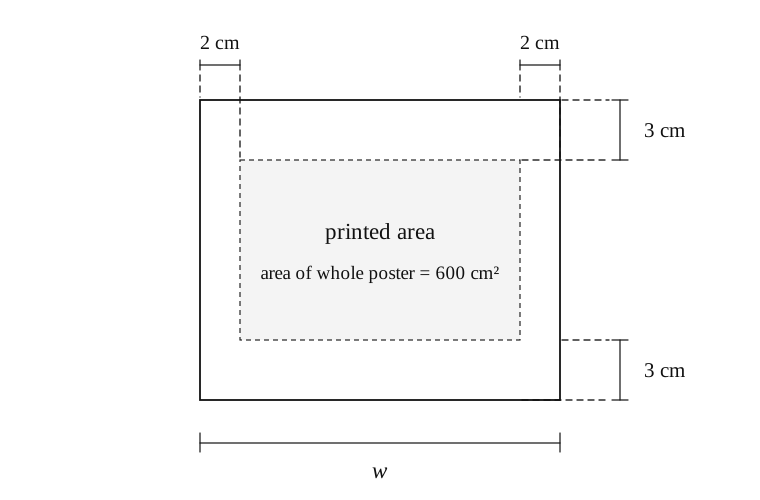
Part (a): Height=w600. Printed area A=(w−4)(w600−6)=624−6w−w2400, with 4<w<100.
Part (b): The derivative is −6+w22400. Setting it to zero gives w2=400, so w=20cm. The second derivative is −w34800<0, confirming a maximum.
Part (c): Height=20600=30cm.
Editorial practice rubric; not an official QCAA marking scheme. Equivalent correct methods are accepted. Method marks may be awarded after an earlier arithmetic error when the subsequent method is valid.
Part (a): Forms A(w)=(w−4)(600/w−6) or 624−6w−2400/w.
[1 mark]
Part (a): States the practical domain 4<w<100, requiring positive printed width and height.
[1 mark]
Part (b): Differentiates to A′(w)=−6+2400/w2.
[1 mark]
Part (b): Solves A′(w)=0 for the valid width w=20cm.
[1 mark]
Part (b): Justifies a maximum using A′′(w)=−4800/w3<0 or a correct derivative sign change.
[1 mark]
Part (c): Calculates the poster height 600/20=30cm.