Q19 · 2025 · Technology-freeComplex unfamiliar5 marks
QUESTION 19 (5 marks)
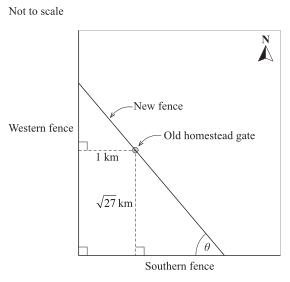
A farmer wishes to construct the shortest possible fence to enclose a triangular area in the corner of a paddock. There are two existing fences, the western fence and the southern fence.
The new fence must pass through the old homestead gate, as shown.
Determine the length of the shortest possible fence.
Verifying that the fence length is a minimum is not required.
Let the new fence be AB and the old homestead gate be H.
AH=cosθ1,HB=sinθ27.
Hence
AB=cosθ1+sinθ27.
Differentiating,
dθd(AB)=(cosθ)2sinθ−(sinθ)227cosθ.
For minimum length, set the derivative equal to zero:
(sinθ)3−27(cosθ)3=0,(tanθ)3=27=(3)3,
so tanθ=3 and θ=60∘.
Then
AB=cos60∘1+sin60∘27=8.
The shortest fence would be 8 km long.
Method 2:
Let H=(1,27). With the horizontal and vertical extensions labelled x and y,
tanθ=1y=x27,
so y=x27. Thus
OB=1+x,OA=27+y=27+x27,
and
AB=(1+x)2+(27+x27)2.
Differentiating,
dxd(AB)=(1+x)2+(27+x27)2(1+x)−x227(27+x27).
For minimum length, set the derivative equal to zero. This gives
x4+x3−27x−27=0,(x+1)(x3−27)=0,
so x=−1 (invalid) or x=3. Substitution gives
AB=8.
The shortest fence would be 8 km long.
correctly determines an expression for the total length of the new fence in terms of the angle θ or a single variable
[1 mark]
determines the derivative of the length expression of the new fence
[1 mark]
determines the angle θ or variable value corresponding to the minimum length
[1 mark]
determines the minimum length of the new fence
[1 mark]
shows logical organisation
[1 mark]
One QCAA sample method typeset for web; criterion wording is adapted from the official marking guide.