Further applications of differentiation — Question 19
QCAA 2022, Paper 1 · 7 marks
Q19 · 2022 · Technology-freeComplex unfamiliar7 marks
QUESTION 19 (7 marks)
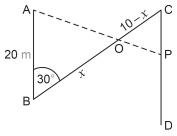
Two triangles are said to be similar if their corresponding angles are congruent and the corresponding sides are in proportion, e.g. if △UVW is similar to △XYZ then ∠U=∠X,∠V=∠Y and ∠W=∠ZandXYUV=YZVW=XZUW. Two parallel walls AB and CD, where the northern ends are A and C respectively, are joined by a fence from B to C. The wall AB is 20 metres long, the angle ABC=30∘ and the fence BC is 10 metres long. A new fence is being built from A to a point P somewhere along CD. The new fence AP will cross the original fence BC at O. Let OB=x metres, where 0<x≤10. Determine the value of x that minimises the total area enclosed by △OBA and △OCP. Verify that this total area is a minimum.
From the labelled diagram, the total area is AT=21(20)xsin30∘+21(10−x)(CP)sin30∘. By similarity, 20CP=x10−x,CP=x20(10−x). Thus AT=5x+x5(10−x)2=x10x2−100x+500=10x+500x−1−100. Differentiate: AT′=10−500x−2. Setting AT′=0 gives x=±50; since x is a positive length, x=50. Also AT′′=x31000, so AT′(50)=0 and AT′′(50)>0; therefore the total area is minimised at x=50.
correctly uses all of the given information to draw a labelled diagram
[1 mark]
correctly establishes a formula for the total area
[1 mark]
correctly determines an expression for CP in terms of x
[1 mark]
determines simplified version of the formula for total area
[1 mark]
determines an equation to solve for stationary points