QCEVault

Further applications of differentiation — Question 88

Original QCE Vault practice · 5 marks

Q88 · Practice questionTechnology-activeComplex familiar5 marks

QUESTION 88 (5 marks)

A closed cylindrical can has volume 500π cm3500\pi\text{ cm}^3. Let its radius be rr cm and height be hh cm. Determine the radius and height that minimise its total surface area.
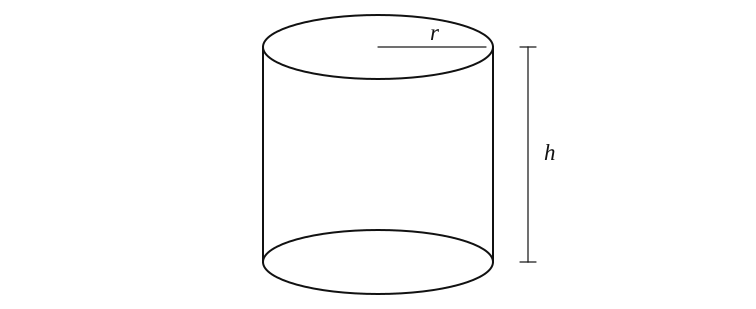
Diagram for question 88
Question link

Related questions

  1. Q13 · 2025 QCAA · Paper 1 · 4 marks
    Use f′′(x)=2x−6f''(x)=2x-6 to demonstrate that the function y=f(x)y=f(x) has a point of inflection at x=3x=3.
    Further applications of differentiation
  2. Q19 · 2025 QCAA · Paper 1 · 5 marks
    A farmer wishes to construct the shortest possible fence to enclose a triangular area in the corner of a paddock. There are two existing fences, the western fence and the southern fence. The new fence must pass through the old homestead gate, as shown.
    Determine the length of the shortest possible fence. Verifying that the fence length is a minimum is not r…
    Further applications of differentiation
  3. Q9 · 2025 QCAA · Paper 2 · 1 mark
    Determine the gradient of the line perpendicular to the tangent to the graph of y=ln⁡(4x)y=\ln(4x) at the point (0.8,1.163)(0.8,1.163).
    Further applications of differentiation
  4. Q10 · 2025 QCAA · Paper 2 · 1 mark
    The outside air temperature, TT (°C), on a particular day at a certain location is modelled by the function T=25−7cos⁡(πt12),0≤t≤24,T=25-7\cos\left(\frac{\pi t}{12}\right),\qquad0\le t\le24, where tt is the time (hours) since 6:00 am. The rate of change of temperature at 11:30 am is
    Further applications of differentiation