QCEVault

Further applications of differentiation — Question 53

Original QCE Vault practice · 1 mark

Q53 · Practice questionTechnology-freeSimple familiar1 mark

QUESTION 53

The graph of f(x)=x3−3xf(x)=x^3-3x is shown. The xx-coordinates of its stationary points are
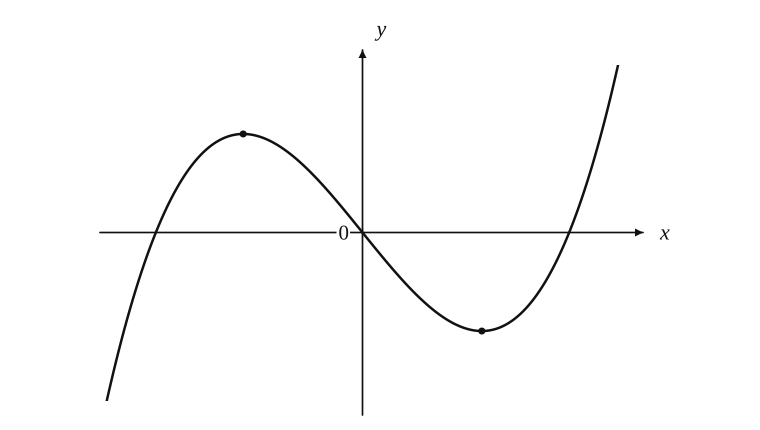
Diagram for question 53
(A)
−3-\sqrt3 and 3\sqrt3
(B)
00 and 11
(C)
−1-1 and 11
(D)
−2-2 and 22
Question linkSyllabus coverage

Related questions

  1. Q3 · Original practice · 1 mark
    The graph shown is the graph of f′(x)f'(x). At which value of xx does ff have a local maximum?
    Further applications of differentiation
  2. Q13 · Original practice · 1 mark
    The stationary points of f(x)=x3−3x2−9x+4f(x)=x^3-3x^2-9x+4 occur when x=x=
    Further applications of differentiation
  3. Q23 · Original practice · 1 mark
    For f(x)=xe−xf(x)=xe^{-x} on x>0x>0, the xx-coordinate of the maximum point is
    Further applications of differentiation
  4. Q28 · Original practice · 4 marks
    A rectangle is inscribed symmetrically under the parabola y=12−x2y=12-x^2 and above the xx-axis, as shown. The upper right corner is (x,12−x2)(x,12-x^2), where 0<x<120<x<\sqrt{12}. Determine the maximum possible area of the rectangle.
    Further applications of differentiation