Further applications of differentiation — Question 338
Original QCE Vault practice · 10 marks
Q338 · Practice questionTechnology-activeComplex unfamiliar10 marks
QUESTION 338 (10 marks)
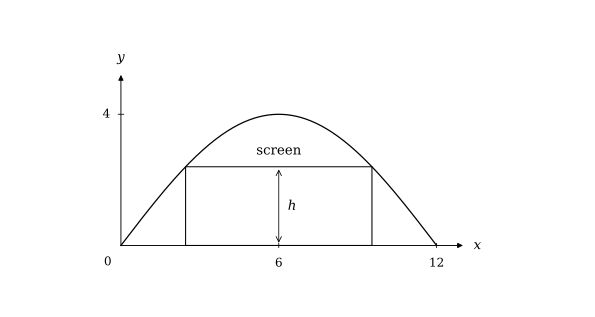
A festival entrance has upper profile y=4sin(πx/12) metres for 0≤x≤12. A rectangular screen stands on the baseline and is centred at x=6. Its top corners touch the profile, and its height is h metres, with 0<h<4.
a)
Show that the screen width is W(h)=12−π24arcsin(h/4).
[2 marks]
b)
Put u=arcsin(h/4). Show that a stationary screen area satisfies tanu=π/2−u.
[3 marks]
c)
Determine the maximum screen area and its dimensions, each to two decimal places. Justify that this is a global maximum.
[3 marks]
d)
Determine the percentage of the entrance area covered by the largest screen, to one decimal place.
a) The left contact is at xL=(12/π)arcsin(h/4) and the right is at 12−xL. Their separation is 12−2xL.
b) Since h=4sinu, A(u)=4sinu(12−24u/π). Differentiating and setting zero gives (π/2−u)cosu−sinu=0. On 0<u<π/2, divide by cosu to obtain the required equation.
c) The unique root is u=0.7104627378…: tanu is increasing while π/2−u is decreasing. The area tends to zero at both ends and its derivative changes from positive to negative at the root. Thus the maximum is global, with h=2.6087384956…, W=6.5724644832… and A=17.1458411086….
d) Entrance area is ∫0124sin(πx/12)dx=96/π. The coverage percentage is 100A/(96/π)=56.10963382…%.
Exact answers unless rounding is specified; equivalent forms accepted.
a) Determines the left contact using inverse sine.