Further applications of differentiation — Question 276
Original QCE Vault practice · 6 marks
Q276 · Practice questionTechnology-freeComplex familiar6 marks
QUESTION 276 (6 marks)
Let f(x)=x3−3x. 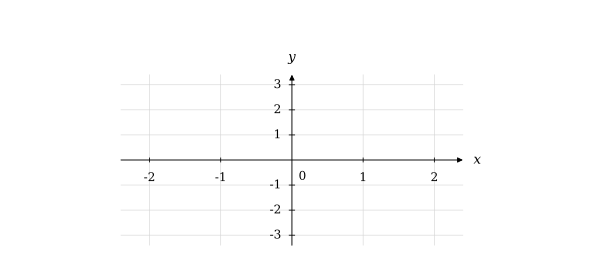
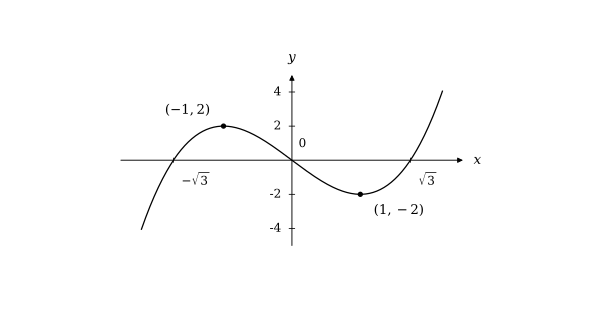
a)Determine and classify the stationary points.
b)Determine the point of inflection.
c)Sketch the graph, labelling its intercepts and stationary points.
ANSWERa) (−1,2) maximum and (1,−2) minimum. c) Intercepts (−3,0), (0,0), (3,0). a) f′=3x2−3=0 at x=±1. Since f′′=6x, (−1,2) is a maximum and (1,−2) is a minimum. b) f′′ changes sign at x=0 and f(0)=0. c) Solve x(x2−3)=0. Draw a cubic rising from bottom left to top right through these intercepts and turning points. Exact answers unless rounding is specified; equivalent forms accepted.
a) Solves the stationary equation.
a) Determines both coordinates.
a) Correctly classifies both.
b) Determines (0,0) with a change in concavity.
c) Labels all intercepts.
c) Draws the correct cubic shape.
Related questions
- Q13 · 2025 QCAA · Paper 1 · 4 marks
Use f′′(x)=2x−6 to demonstrate that the function y=f(x) has a point of inflection at x=3. - Q19 · 2025 QCAA · Paper 1 · 5 marks
A farmer wishes to construct the shortest possible fence to enclose a triangular area in the corner of a paddock. There are two existing fences, the western fence and the southern fence.
The new fence must pass through the old homestead gate, as shown.
Determine the length of the shortest possible fence.
Verifying that the fence length is a minimum is not r…
- Q9 · 2025 QCAA · Paper 2 · 1 mark
Determine the gradient of the line perpendicular to the tangent to the graph of y=ln(4x) at the point (0.8,1.163). - Q10 · 2025 QCAA · Paper 2 · 1 mark
The outside air temperature, T (°C), on a particular day at a certain location is modelled by the function T=25−7cos(12πt),0≤t≤24, where t is the time (hours) since 6:00 am.
The rate of change of temperature at 11:30 am is