QCEVault

Further applications of differentiation — Question 243

Original QCE Vault practice · 1 mark

Q243 · Practice questionTechnology-freeSimple familiar1 mark

QUESTION 243

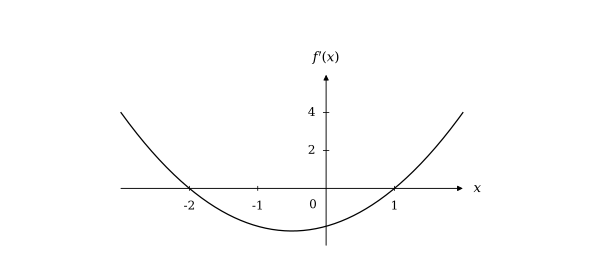
The graph shows f′(x)=(x+2)(x−1)f^{\prime}(x)=(x+2)(x-1). At which value of xx does ff have a local maximum?
Upward-opening graph of f prime(x)=(x+2)(x-1), crossing the horizontal axis at -2 and 1.
(A)
−2-2
(B)
11
(C)
22
(D)
−12-\dfrac12
Question link

Related questions

  1. Q13 · 2025 QCAA · Paper 1 · 4 marks
    Use f′′(x)=2x−6f''(x)=2x-6 to demonstrate that the function y=f(x)y=f(x) has a point of inflection at x=3x=3.
    Further applications of differentiation
  2. Q19 · 2025 QCAA · Paper 1 · 5 marks
    A farmer wishes to construct the shortest possible fence to enclose a triangular area in the corner of a paddock. There are two existing fences, the western fence and the southern fence. The new fence must pass through the old homestead gate, as shown.
    Determine the length of the shortest possible fence. Verifying that the fence length is a minimum is not r…
    Further applications of differentiation
  3. Q9 · 2025 QCAA · Paper 2 · 1 mark
    Determine the gradient of the line perpendicular to the tangent to the graph of y=ln⁡(4x)y=\ln(4x) at the point (0.8,1.163)(0.8,1.163).
    Further applications of differentiation
  4. Q10 · 2025 QCAA · Paper 2 · 1 mark
    The outside air temperature, TT (°C), on a particular day at a certain location is modelled by the function T=25−7cos⁡(πt12),0≤t≤24,T=25-7\cos\left(\frac{\pi t}{12}\right),\qquad0\le t\le24, where tt is the time (hours) since 6:00 am. The rate of change of temperature at 11:30 am is
    Further applications of differentiation