Q355 · Practice questionTechnology-freeComplex familiar6 marks
QUESTION 355 (6 marks)
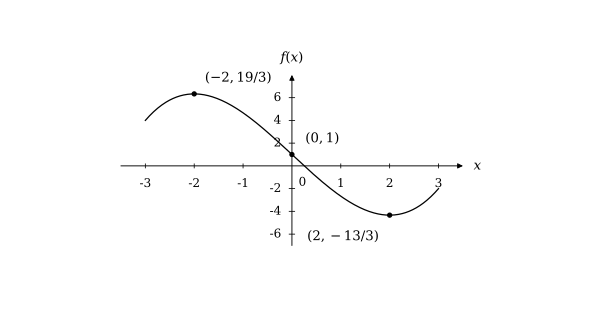
The graph of is shown on the left. It is known that . Use the grid on the right for your sketch.
![Left: derivative graph x squared minus 4 on [-3,3]. Right: blank Cartesian grid for a student sketch, x from -3 to 3 and y from -7 to 7.](/qce-data/assets/methods-2026-MM26-AUD-117-mobile.svg)
a)[2 marks]
Determine and classify both stationary points of .
b)[1 mark]
Determine the point of inflection of .
c)[3 marks]
Sketch a possible graph of for , labelling the points found in parts a) and b).
WORKED SOLUTION
6 marksPractice marking scheme
ANSWER
a) Local maximum ; local minimum . b) Inflection . c) A valid sketch is the graph of on .
Worked solution
Integrating gives , and gives .
a) The derivative changes at and at . Substitute into for the ordinates.
b) changes sign at , giving inflection .
c) The sketch increases, decreases, then increases; concavity changes from down to up at . Endpoints are and .
Exact answers unless rounding is specified; equivalent forms accepted. Retain unrounded intermediate values.
Locates and classifies both stationary x-values.
Determines both stationary y-values.
Locates the inflection and identifies the change in concavity.
Sketches the correct increasing and decreasing sections.
Shows both stationary points and the given point.
Shows correct concavity and endpoints on the stated domain.
Practice question aligned to the current QCAA syllabus; review the worked solution and marking criteria.
View the QCAA syllabusHow many marks did you earn?
Compare your working with the guide above.