QUESTION 100 (20 marks)
Use all sources to recommend a national policy mix for the two regions. Evaluate using price stability, full employment and equity. Explain why neither one national cash-rate change nor identical fiscal spending in both regions is sufficient by itself.
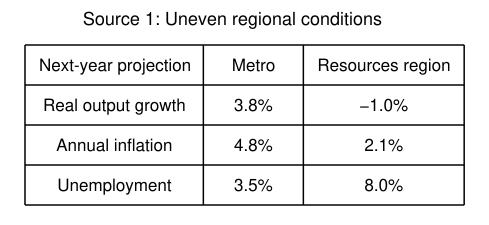
Source 1
Regional projections use the same unchanged national policy settings.
Source 2
Metro’s high spending is concentrated in interest-sensitive services and housing. Construction inputs there are scarce.
Source 3
The resources region has lost export orders. Many displaced workers need new qualifications before taking available renewable-maintenance jobs.
Source 4
National underlying inflation is 4.2% and is forecast to remain above 3% next year under a hold. A national cash-rate rise is forecast to reduce aggregate inflation, but also depress investment in both regions. Targeted retraining and infrastructure have implementation lags; a temporary income bridge can be delivered sooner.
Practice marking scheme
Answer
Use proportionate national inflation management with targeted regional income, matching and capacity measures.
Working
Source 1 shows Metro growing 3.8% with 4.8% inflation and 3.5% unemployment, while the resources region contracts 1% with 2.1% inflation and 8% unemployment. National restraint can address Metro’s interest-sensitive demand (Source 2), but the same instrument weakens investment and employment in the already contracting region (Source 4). Identical construction spending would add pressure where inputs are scarce and may not resolve the other region’s qualifications mismatch. Target retraining to renewable-maintenance vacancies and stage useful infrastructure in the resources region (Source 3), with temporary income protection during the lag. Monetary policy cannot set separate regional cash rates and cannot create missing skills. A coordinated mix can reduce aggregate inflation while limiting unequal employment losses. Funding, mobility, leakage and delivery uncertainty constrain it; monitor regional job retention and inflation rather than assuming national averages describe every household.
Marking criteria
- Analyses the contrasting growth, inflation and unemployment data. [4 marks]
- Explains national monetary transmission and regional trade-offs. [4 marks]
- Explains why uniform fiscal spending and demand stimulus do not resolve all constraints. [4 marks]
- Justifies complementary targeted measures using all three criteria. [4 marks]
- Addresses timing, equity and fiscal opportunity costs. [2 marks]
- Qualifies forecasts and proposes meaningful monitoring. [2 marks]
Practice question aligned to the current QCAA syllabus; review the worked solution and marking criteria.
View the QCAA syllabusCompare your working with the guide above.