QUESTION 99 (20 marks)
Use all sources to assess a claim that a tax-funded education package is economically neutral because government purchases and tax receipts are equal. Evaluate the package using sustainable growth and equity.
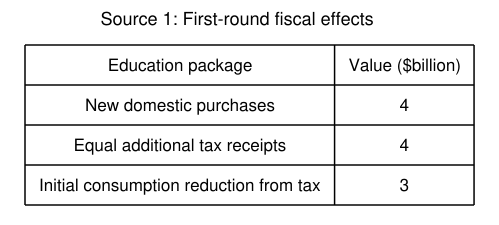
Source 1
These are the first-round effects; do not assume a complete open-economy multiplier.
Source 2
The purchases are local training services. Half of places are reserved for workers displaced by industry restructuring.
Source 3
Additional taxation is concentrated among higher-income households. Training takes two years; employers report shortages in the targeted qualifications.
Source 4
Course quality is uncertain. Existing training providers may receive funding for places they would otherwise have supplied privately.
Practice marking scheme
Answer
A balanced funding change need not be demand-neutral; the net initial AD increase is $1 billion, with conditional capacity and equity benefits.
Working
New G adds $4 billion while reduced C subtracts $3 billion, giving a $1 billion first-round demand increase (Source 1). Equal budget funding is not the same as equal spending effects. No full multiplier is calculated because later leakages and responses are unspecified. Training targeted to displaced workers and relevant vacancies can reduce structural mismatch and raise capacity after two years (Sources 2–3). Higher-income funding and reserved places support equity, though effective access also depends on location and living costs. Source 4 threatens additionality: weak courses or substitution for privately funded places reduce the expected gains. Support the package conditionally with accredited courses, competitive procurement and outcome evaluation. Near-term demand should be assessed against capacity and inflation, while longer-run benefits should be judged by useful skills, retention and productivity.
Marking criteria
- Calculates and explains the $1 billion first-round AD effect. [3 marks]
- Distinguishes budget balance from demand neutrality and avoids an unsupported multiplier. [3 marks]
- Evaluates matching, training lags and sustainable output. [4 marks]
- Uses the tax/eligibility evidence to assess equity. [3 marks]
- Justifies a conditional judgement integrating quality and additionality. [5 marks]
- Explains appropriate evidence for outcome evaluation. [2 marks]
Practice question aligned to the current QCAA syllabus; review the worked solution and marking criteria.
View the QCAA syllabusCompare your working with the guide above.