QUESTION 98 (20 marks)
Use all sources to evaluate immediate against staged construction of a commuter rail project. Recommend a schedule using economic efficiency and price stability. Include the opportunity cost of delay.
Source 1
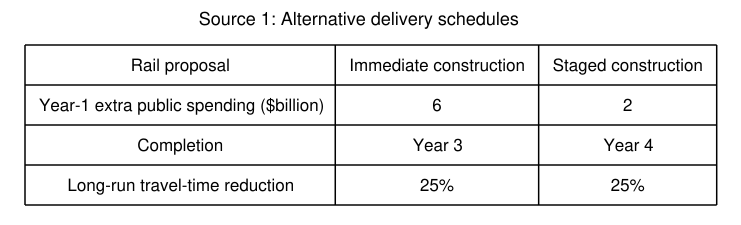
The two schedules deliver the same eventual capacity.
Source 2
Construction unemployment is low; major suppliers have lengthy queues. Starting immediately risks an estimated 15% real cost overrun.
Source 3
Delaying completion by a year postpones lower travel times, wider job access and reduced road congestion.
Source 4
Inflation is above target. The central bank has already tightened monetary policy, and private construction investment is beginning to weaken.
Practice marking scheme
Answer
Staging is defensible given bottlenecks and inflation, but the delayed transport benefits must be weighed explicitly.
Working
Immediate delivery adds $6 billion of Year-1 demand versus $2 billion staged, a $4 billion difference (Source 1). With scarce inputs and a 15% overrun risk (Source 2), faster spending may inflate costs or crowd out existing projects rather than proportionately increase output. Staging can coordinate with weakening private construction and monetary restraint (Source 4). However, completion shifts from Year 3 to Year 4, postponing the same 25% travel-time reduction and wider employment access (Source 3). A staged schedule is preferable if avoided resource waste exceeds the value of a year’s delayed benefits; estimates of usage, congestion and overruns are needed. Protect essential early works and review capacity during delivery. The nominal size of spending is not itself a measure of efficiency, and a well-supported immediate schedule remains defensible if delay costs are sufficiently high.
Marking criteria
- Uses the spending/completion/capacity comparisons. [3 marks]
- Explains scarce inputs, crowding out and real overruns. [4 marks]
- Integrates monetary conditions and price stability. [3 marks]
- Evaluates delayed benefits and the opportunity cost. [4 marks]
- Justifies a schedule using both criteria rather than spending totals alone. [4 marks]
- Identifies a relevant missing valuation or delivery uncertainty. [2 marks]
Practice question aligned to the current QCAA syllabus; review the worked solution and marking criteria.
View the QCAA syllabusCompare your working with the guide above.