QUESTION 94 (20 marks)
A tourism region has lost international visitors. Use all sources to evaluate a temporary festival rebate and an airport/skills upgrade. Recommend a policy mix using regional employment and sustainable economic growth.
Source 1
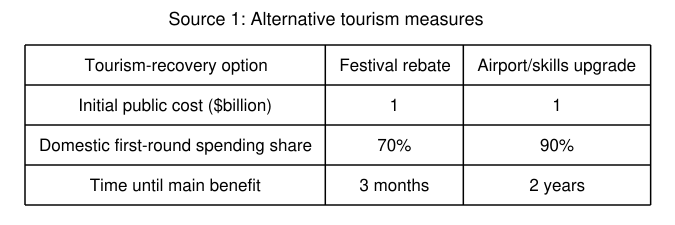
The domestic share applies to the initial public expenditure; do not assume a complete multiplier.
Source 2
Hotels have empty rooms and underemployed staff. Visitor arrivals are forecast to recover next year if overseas incomes improve.
Source 3
The airport has recurring delays. Employers struggle to recruit specialist maintenance workers, which constrains peak-season capacity.
Source 4
A stronger Australian dollar has made the destination more expensive to overseas visitors and lowered imported-equipment costs.
Practice marking scheme
Answer
Temporary targeted demand support can address current slack, alongside a staged capacity upgrade justified by the identified bottlenecks.
Working
The rebate retains $0.70 billion initially in domestic spending and arrives quickly; the upgrade retains $0.90 billion but its principal operating benefits take two years (Source 1). Empty rooms and idle staff support near-term demand measures (Source 2), but recovery is conditional on overseas incomes and currency competitiveness. Airport delays and skill shortages support a longer-term supply response (Source 3). Appreciation weakens foreign purchasing power for local holidays while making imported upgrade equipment cheaper (Source 4). A staged mix can bridge present employment weakness without assuming permanent festival subsidies will solve capacity problems. Eligibility and local sourcing should improve additionality; the airport project needs demand and cost assessment. Fiscal opportunity cost, leakage and a slower foreign recovery could weaken outcomes. Regional jobs should be assessed net of displacement from other Australian destinations.
Marking criteria
- Calculates the $0.70b and $0.90b first-round domestic amounts. [3 marks]
- Explains current slack versus future capacity constraints. [3 marks]
- Integrates exchange-rate and overseas-income influences. [4 marks]
- Evaluates timing, employment and sustainable-growth trade-offs. [4 marks]
- Justifies a policy mix with additionality and opportunity costs. [4 marks]
- Recognises a forecast or regional-displacement limitation. [2 marks]
Practice question aligned to the current QCAA syllabus; review the worked solution and marking criteria.
View the QCAA syllabusCompare your working with the guide above.