QUESTION 93 (20 marks)
Use all four sources to evaluate two ways to reduce the structural deficit: an equal percentage cut to every spending program or a revenue-base reform with protected low-income transfers. Recommend a strategy using fiscal sustainability and equity.
Source 1
The estimates exclude cyclical weakness.
Source 2
An across-the-board cut would save $20 billion annually. It includes skills programs and preventative health services as well as administration.
Source 3
Revenue-base reform would raise $24 billion annually; associated targeted transfer protection would cost $4 billion. Most additional revenue is paid by higher-income households.
Source 4
The economy has unused capacity. Both options reduce near-term demand; the reform requires one year of administration changes.
Practice marking scheme
Answer
Revenue-base reform with protected transfers is the better supported choice, preferably phased during weak activity.
Working
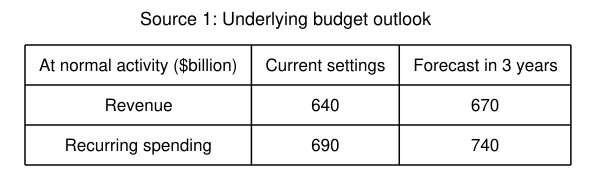
The estimated underlying deficit grows from 690 − 640 = $50 billion to 740 − 670 = $70 billion, a $20 billion deterioration (Source 1). Both alternatives provide a $20 billion net annual improvement: the cut directly saves 20; reform raises 24 less 4 of protection. Neither alone closes the projected $70 billion gap. Equal cuts ignore differences in service value and may weaken future skills and health capacity (Source 2). Reform concentrates revenue collection at higher incomes and protects vulnerable households (Source 3), making it better supported on equity. Source 4 argues for phasing because demand is already weak; cyclical stabilisers should not be mistaken for the structural problem. Implementation capacity, behavioural responses and the opportunity cost of protected spending require review. Combining targeted efficiency improvements with reform could be defensible, but claiming an immediate balanced budget would contradict the numbers.
Marking criteria
- Calculates both structural deficits and the deterioration. [4 marks]
- Calculates the equal $20 billion net improvements and residual gap. [3 marks]
- Evaluates distribution and service/capacity effects. [4 marks]
- Explains weak-demand and implementation trade-offs. [3 marks]
- Justifies a criteria-based strategy integrating all sources. [4 marks]
- Recognises estimates, behaviour or delivery uncertainty. [2 marks]
Practice question aligned to the current QCAA syllabus; review the worked solution and marking criteria.
View the QCAA syllabusCompare your working with the guide above.