QUESTION 92 (20 marks)
A government is choosing a response to an ageing population. Use all four sources to evaluate a savings incentive and work/training support. Recommend the more effective option using sustainable economic growth and equity.
Source 1
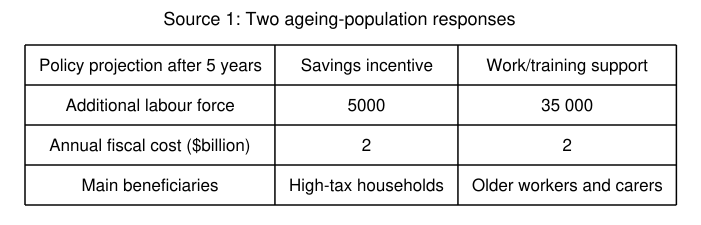
Projection estimates are conditional on participation and take-up.
Source 2
Retirees with limited savings face hardship. The proposed non-refundable savings credit is unavailable to households with no income-tax liability.
Source 3
Employers report skill shortages. Training completion takes two years; flexible hours and childcare can remove participation barriers earlier.
Source 4
Some additional saving finances domestic investment, but participation in the incentive may partly replace existing saving rather than create new saving.
Practice marking scheme
Answer
Work/training support is better supported for broad capacity and equity, with targeted retirement-income protection as a complement.
Working
At equal fiscal cost, Source 1 projects seven times as many additional labour-force participants under support (35 000 versus 5000). Source 3 links the intervention to real shortages and participation barriers, so it can expand effective labour supply and sustainable output. The two-year training lag requires staged delivery and suitable vacancies. The savings incentive could support capital formation (Source 4), but substitution for existing saving reduces additionality. Its non-refundable design excludes no-tax-liability households facing hardship (Source 2), weakening equity. Work support is therefore the stronger main choice on the stated criteria, but not everyone can return to work: an appropriate safety net remains important. Higher participation can temporarily raise measured unemployment if matching is slow; that is different from permanent job destruction. Evaluate net jobs, retention, access and productive investment as the program matures.
Marking criteria
- Explains ageing, effective labour supply and productive capacity. [3 marks]
- Uses equal cost and the 7:1 participant comparison. [4 marks]
- Evaluates credit eligibility and retirement hardship using equity. [4 marks]
- Evaluates training lags, job matching and savings additionality. [4 marks]
- Synthesises a recommendation with relevant complementary protection. [3 marks]
- Explains a meaningful uncertainty or monitoring measure. [2 marks]
Practice question aligned to the current QCAA syllabus; review the worked solution and marking criteria.
View the QCAA syllabusCompare your working with the guide above.