QUESTION 15 (26 marks)
The Australian Government is reviewing the economic issue of rental housing.
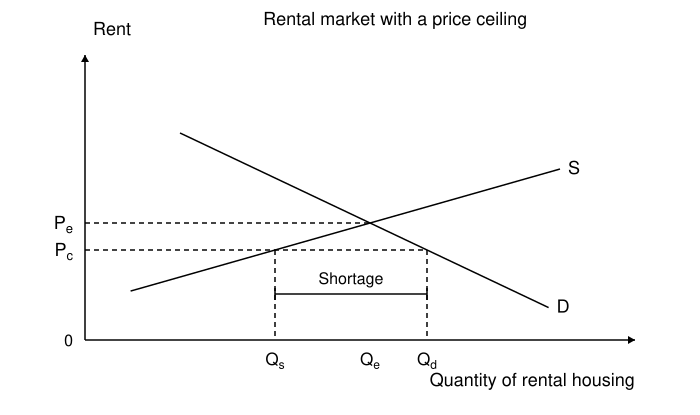
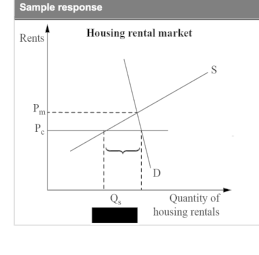
a) Draw a demand and supply diagram that represents a situation where the government places a limit on housing rent rises, resulting in a price ceiling.
[4 marks]
b) Analyse the economic issue of rental housing in Australia. Using the criterion of living standards, recommend the most appropriate government policy option from the table shown to address this issue.
Policy option 1 | Policy option 2 |
Housing rent control | Limit holiday accommodation nights |
In your response, use all sources 1–8 in the stimulus book. Refer to the price ceiling diagram from Question 15a) where appropriate.
[22 marks]
Stimulus book
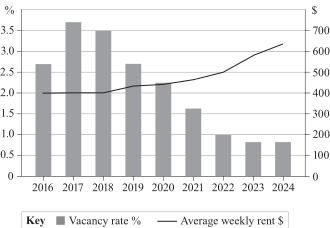
Source 1: Brisbane housing rental market
Source 2: Economic commentary, 2025 The supply of public housing* has been trending downwards for decades. The government’s current initiatives to help renters involve the private sector. *Government owned and managed rentals.
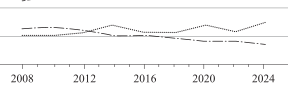
Source 3: Renter households by age
%
50
40
30
Key 15–24 years
20
25–44 years 45–64 years
10
65+ years
0
Source 4: Economic commentary, 2024 Holiday accommodation supply has risen significantly over the last decade, with owners choosing short-term holiday accommodation instead of long-term housing rentals. Holiday accommodation in Australia is estimated to be 3% of the nation’s existing 11 million homes. Holiday lettings earn an average annual premium of 40% above annual residential housing rents.
Source 5: Market analysis, 2024 While Australia has not applied housing rent controls, other similar countries have used various forms of price restrictions over a long time to limit rent increases and improve housing affordability. These experiences have exposed a range of viewpoints on their success. For example, unchangeable rents keep housing cheaper but have consequences on the quantity and quality of housing available in the market.
Source 6: Distribution of housing occupancy in Australia by wealth quintile*, 2024
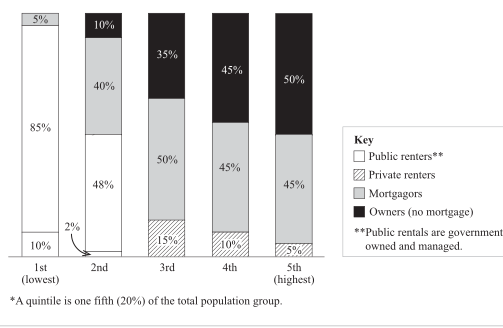
*A quintile is one fifth (20%) of the total population group.
Source 7: Research findings, 2023 The Journal reviewed a country’s housing market. In 2015, laws were introduced in that country to encourage maintenance and improvements in rent-controlled housing*. Within four years of the new laws, 30% of rent-controlled housing was withdrawn. Houses were then renovated to reappear in the market as holiday accommodation that had no rent control. *Rent control is a policy that limits how much rental prices can be raised.
Source 8: Newspaper commentary, 2024 Major cities in some countries have set limits of 30–90 nights per year that an entire home can be booked as holiday accommodation. Local authorities enforce these regulations vigorously, acting on complaints from neighbours about noise and traffic. In Australia, by comparison, most major cities do not have any limits on holiday accommodation nights.
QCAA guide · typeset solution
QCAA sample response and mark allocation
Extended response — Question 15 (26 marks) Question 15a) (4 marks)
Sample response | The response: |
• identifies an informative title [1 mark] • draws a D and S diagram accurately [1 mark] • labels the D and S lines, and axes appropriately [1 mark] • identifies the shortage created by the price ceiling [1 mark] |
Question 15b) (22 marks)
Criterion: Analysing (9 marks)
The response: | The response: |  | The response: | M |
Problem (3 marks) (s1, 2, 3) | Rental data (s1) | Housing occupancy (s6) | ||
• describes the economic problem as 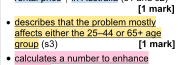 | • describes the trend of ↓ vacancies using dates and data • describes the ↑ in rental prices using dates and data • explains that the ↓ vacancies are causing rents to ↑ | 3 | • describes the renting pattern in the lowest wealth quintile/s in Australia, using data • interprets one pattern described • makes a comparison to the highest quintile, with data | 3 |
• describes ↓ vacancies and ↑ rents with one data point • identifies a connection between vacancies and rents | 2 | • describes the renting pattern in the lowest wealth quintile/s • interprets one pattern or makes a comparison | 2 | |
• describes the trend of ↓ vacancies and ↑ rents | 1 | • identifies that renting is most common in the lowest wealth quintile | 1 | |
• does not satisfy any of the descriptors above. | 0 | • does not satisfy any of the descriptors above. | 0 | |
Criterion: Evaluating (13 marks)
The response: | The response: | M | The response: | M | The response: | M |
Economic ideas (2 marks) | Option 1: housing rent control (s5 and s7) | Option 2: limit holiday accommodation nights (s4 and s8) | Evaluation | |||
• uses the diagram to describe the price ceiling and shortage 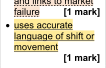 | • describes option 1, identifying an example from each stimulus • explains the price ceiling effect could impact landlords’ incentive to supply housing rentals • explains likely flow-on effects of housing rent control, with data | 4 | • describes option 2, identifying an example from each stimulus • explains how more housing rental supply might be created, with data • identifies that not all holiday accommodation rentals might be impacted • explains likely flow-on effects of limiting holiday accommodation nights | 4 | • makes a valid decision about 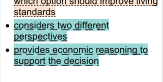 | 3 |
• describes option 1, identifying an example from either stimulus • describes that landlords may provide less housing rentals • explains a likely flow-on effect of option 1, with data | 3 | • describes option 2, identifying an example from either stimulus • explains how more housing rental supply might be created, with data • identifies a likely flow-on effect of option 2 | 3 | • makes a valid decision about which option should improve living standards • provides economic reasoning to support the decision | 2 | |
• describes that landlords may provide less housing rentals • describes another likely effect of option 1 | 2 | • describes that holiday accommodation could move into housing rentals • describes another likely effect of option 2 | 2 | • makes a decision about which option should improve living standards | 1 | |
• describes option 1 with a relevant detail or likely effect | 1 | • describes option 2 with a relevant detail or likely effect | 1 | • does not satisfy any of the descriptors above. | 0 | |
• does not satisfy any of the descriptors above. | 0 | • does not satisfy any of the descriptors above. | 0 | |||
QCAA sample response and marking criteria reproduced from the official guide.
Compare your working with the guide above.