QUESTION 15 (21 marks)
Use all of Sources 1–8 to analyse the economic issue and evaluate a demand-side and a supply-side approach being taken by Australian governments. Draw a conclusion about which approach is more effective, using the criterion of future employment.
Stimulus book
Source 1: Extreme global weather events, 1945 to 2024
Storm | Flood | Drought | Other | |
1945–1964 | 200 | 80 | <10 | <10 |
1965–1984 | 380 | 420 | 25 | 21 |
1985–2004 | 1390 | 1450 | 340 | 360 |
2005–2024 | 2000 | 3200 | 400 | 680 |
Source 2: State Government media release, 2024
The $5 billion CopperString Project 2032 is the largest expansion to the power grid in Australia. It links to the North West Minerals Province (375 000 square kilometres), an area that contains one of the world’s richest deposits of critical minerals, worth an estimated $500 billion.

Full cost after federal government subsidies are paid to you!
Source 4: Scientific statement There is evidence that non-renewable energy is a major contributor to climate change due to carbon emissions. Australian weather disasters are damaging food, transport and major export industries and assets.
Source 5: Global carbon emissions by source, 2023
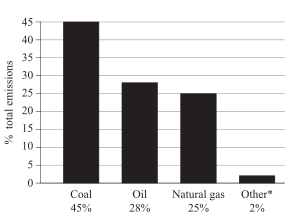
*Including renewable energy sources
Source 6: National electricity generation by fuel type
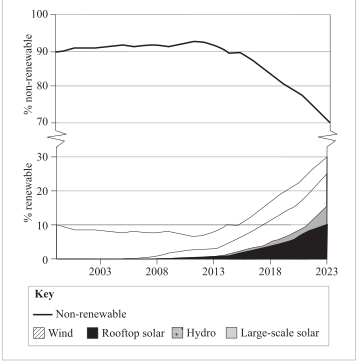
Source 7: Economic commentary, 2024 Emerging technologies rely on critical minerals that are important to the production of electric vehicles, renewable energy projects and storage, and low-emission power sources. The location of these minerals is accessed through a small, separate power grid that is gas-fired. The existing system is not enough for processing minerals or associated manufacturing.
Source 8: Global solar production employment, top 10
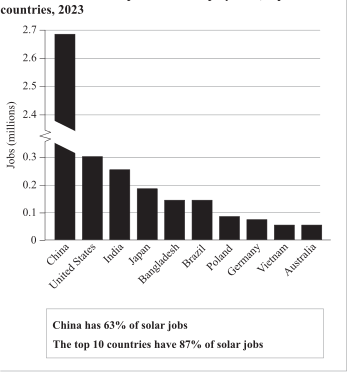
The top 10 countries have 87% of solar jobs
QCAA guide · typeset solution
QCAA sample response and mark allocation
Extended response — Question 15 (21 marks)
Criterion: Analysing
The response: | The response: |  | The response: |  |
Problem (3 marks) | Weather events | Electricity generation | ||
• explains the economic issue as extreme weather [1 mark] events • identifies the dilemma for Australia of reliance on [1 mark] non-renewable energy production • calculates a number to make meaning [1 mark] | • quantifies flood and storm event trends using data and dates (s1) • adds meaning to the damage caused by weather events, with detail (s4) | 3 | • quantifies the - % of two carbon emission sources (s5) - trend of electricity generation from non-renew and renew sources (s6) • adds meaning to the data (s5 or s6) | 3 |
• quantifies flood or storm event trends • adds meaning to the damage caused by weather events | 2 | • using data, identifies the carbon emission sources • adds meaning to the data OR • using data, identifies the trend of electricity generation • adds meaning to the data | 2 | |
• identifies flood or storm event trends OR • identifies damage caused by weather events | 1 | • identifies carbon emission sources OR • identifies the trend of electricity generation | 1 | |
• does not satisfy any descriptors above. | 0 | • does not satisfy any descriptors above. | 0 | |
Criterion: Evaluating
The response: | M | The response: | M | The response: | M |
D-side approach | S-side approach | Evaluation | |||
• explains solar subsidies as stimulating demand for solar (s3) • adds detail to the solar subsidy explanation • synthesises a relevant idea or perspective, with detail | 4 | • explains CopperString as increasing the supply of electricity (s2) • adds detail to the CopperString explanation • synthesises a relevant idea or perspective, with detail | 4 | • makes a valid decision about the effectiveness of the D- and S-side approaches, using future employment (s7, s8) • provides economic reasoning about the D- and S-side approaches • makes a valid decision about whether the D- or S-side approach is more effective | 4 |
• explains solar subsidies • synthesises a relevant idea or perspective • adds details to either the explanation or synthesis | 3 | • explains CopperString • synthesises a relevant idea or perspective • adds details to either the explanation or synthesis | 3 | • makes a decision about the effectiveness of the either the D-side OR S side approach, using future employment • includes economic reasoning to support one approach | 3 |
• describes solar subsidies • refers to an economic idea or perspective | 2 | • describes CopperString • refers to an economic idea or perspective | 2 | • makes a decision about the D-side or S-Side approach • links a decision to employment | 2 |
• identifies solar subsidies as an approach | 1 | • identifies CopperString as an approach | 1 | • identifies a decision about employment | 1 |
• does not satisfy any descriptors above. | 0 | • does not satisfy any descriptors above. | 0 | • does not satisfy any descriptors above. | 0 |
QCAA sample response and marking criteria reproduced from the official guide.
Compare your working with the guide above.