QUESTION 13 (11 marks)
Hypothetical annual data for an economy similar to Australia’s economy is shown.
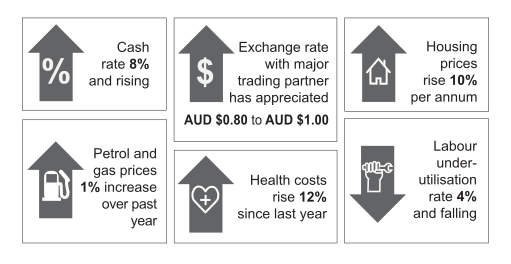
Analyse the data to decide whether its central bank should continue its current monetary policy stance.
QCAA guide · typeset solution
QCAA sample response and mark allocation
Question 13 (11 marks)
Sample response | The response: |
The economy appears to be in an expansionary phase of the economic cycle. This is evidenced by the low labour underutilisation rate of 4% and falling,  annually, which may reflect falling international prices for oil or the dollar’s appreciation. With the appreciation of the economy’s dollar to parity with its major trading partner, export demand should be falling. This is because export prices would be rising, making them less competitive in international markets. Further, demand for imports would be rising, as their prices fall due to the dollar’s appreciation, meaning greater withdrawals from the economy and contractionary forces. Consequently, assuming the data is representative of the whole economy, the central bank could hold off on further cash rate rises while it monitors opposing forces within the economy. | Expansionary (4 marks) |
[1 mark] • identifies inflation pressures exist | |
[1 mark] • interprets labour forces as expansionary, using data | |
[1 mark] • interprets ↑ health costs as inflationary, using data | |
[1 mark] • interprets ↑ housing costs as inflationary, using data | |
Contractionary (4 marks) | |
• identifies offsetting contractionary forces exist [1 mark] | |
• interprets petrol prices are not inflationary, using data [1 mark] | |
• interprets $AUD effect on exports as contractionary [1 mark] | |
• interprets $AUD effect on imports as contractionary [1 mark] | |
Decision (3 marks) | |
[1 mark] • makes a decision about MP movements | |
[1 mark] • provides reasoning for the decision made | |
[1 mark] • describes a caveat |
QCAA sample response and marking criteria reproduced from the official guide.
Compare your working with the guide above.