QUESTION 15 (22 marks)
Use all Sources 1–8 in the stimulus book to prepare your response. Explain the rationale for the scenario presented to reduce payroll tax in Australia. Evaluate the benefits and costs using the perspectives of households, businesses and government.
Stimulus book
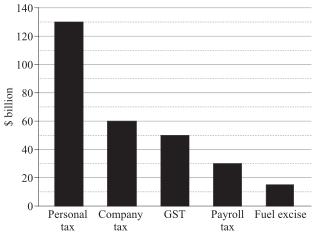
Source 1: Excerpt from article In an era of low unemployment, payroll tax policy and its implementation across Australia are controversial. Payroll tax, on average around 5%, is levied by states and paid by employers based on employees’ salaries ... It is the largest state and territory-levied tax, providing $30 billion in revenue in 2022.
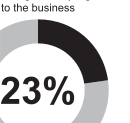
Source 2: Excerpt from 2021 survey of Australian businesses that pay payroll tax
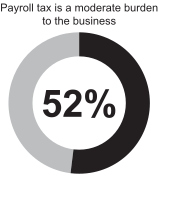
Payroll tax is a high or very high burden
Source 3: The top five taxes paid in Australia by revenue, 2022
Source 4: Excerpt from 2021 survey of Australian businesses that pay
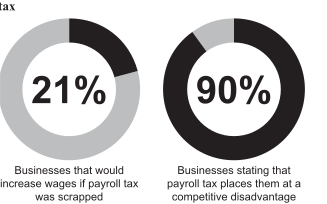
Half of businesses would employ more people without payroll tax
Source 5: Comment from industry representative ‘Some stakeholders criticise payroll tax on the grounds that it is a tax on employment and as such acts as a drag on economic activity ... However, in practice, the cost of paying the tax can be passed on either to employees ... or to consumers ...’
Source 6: Payroll tax as a percentage of taxes raised, 2022
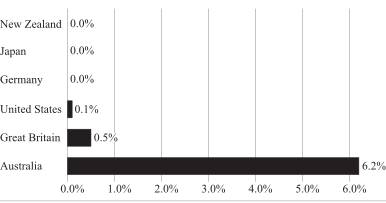
Source 7: Excerpt from news article, 2023 The problems associated with the deficit are increased by spending pressures during 2020–22. Spending as a share of gross domestic product (GDP) is projected to grow in terms of public investment needs, including government interest payments.
Source 8: Payroll tax in Australia, 2022
State | Annual threshold | Tax rate |
Victoria | $650 000 | 4.85% or 2.43% for regional employers |
New South Wales | $1 200 000 | 4.85% |
Western Australia | $1 000 000 >$1 m and <$7.5 m >$100 m and <$1.5 b Above $1.5 b | 5.50% 5.50% See Note See Note |
Queensland | Under $1 300 000 $1.3 m to $6.5 m Above $6.5 m | 0% 4.75% or 3.75% for regional employers 4.95% |
Note: 5% for wages up to $100 million + 6% for wages from $100 million to $1.5 billion + 6.5% for wages above $1.5 billion.
QCAA guide · typeset solution
QCAA sample response and mark allocation
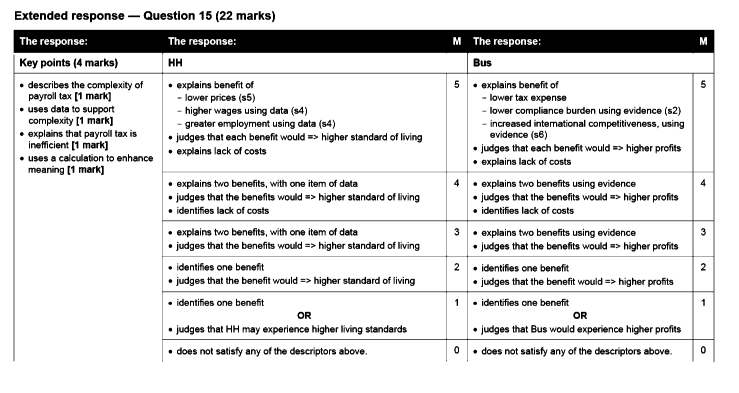
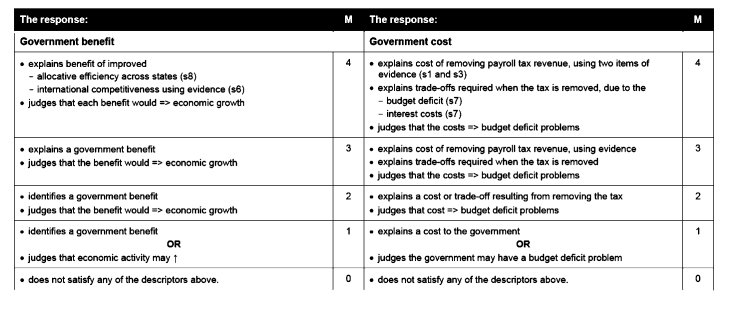
QCAA sample response and marking criteria reproduced from the official guide.
Compare your working with the guide above.