QUESTION 14 (28 marks)
Sources 1 7 in the stimulus book present the Australian economy in a fictional setting. Analyse Sources 1 7 to evaluate the costs and benefits of changing the monetary policy stance from the perspective of Australian households.
Stimulus book
Source 1: Spending in Australia
Key Durable1 goods
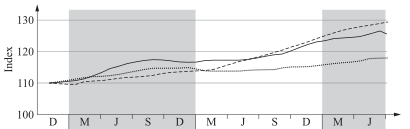
and services consumption Machinery and equipment investment
Non-durable goods and services consumption
Note: Quarterly periods end in December (D), March (M), June (J) and September (S).
1 able to last or be used over a long time
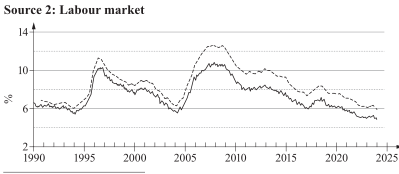
Key Hours underutilisation rate2 Unemployment rate
2 a measure of unused capacity in the labour market
Source 3: Pension incomes, 2024 The government pension remains a main source of income for many retirees. ‘About 3 million Australian households need their personal savings to support themselves’, according to a government spokesperson.
Source 4: Census data In recent times, there has been much public debate about the rate of home ownership and housing affordability. According to the 2023 Census of Population and Housing, there were nearly 8.8 million households in Australia. Where household tenure was known, 67% (5.9 million households) were homeowners, of which 48% (2.8 million) did not have a mortgage. Further, 32% (1.9 million households) were renters.
Source 5: Household debt as a percentage of net disposable income, 2024
250
200
150 %
United Kingdom
100
New Zealand United States
Switzerland
Germany
Australia
50
Canada
0
Country
QCAA guide · typeset solution
QCAA sample response and mark allocation
Section 3: Extended response — Question 14
Criterion: Analysing
The response: | The response: | M | The response: | M | The response: | M |
Problem (2 marks) | Durable goods (Sources 1 and 7) | Labour market (Source 2) | Business (Source 6) | |||
• identifies the economic problem being an overheated economy [1 mark] • calculates a number to make meaning [1 mark] | • quantifies the trend in durable goods, using data from s1 and links to s7 • effectively provides a detailed explanation of a relationship • infers household demand is high | 4 | • quantifies the trend in the labour market, using data from s2 and with links to labour being at full capacity • effectively provides a detailed explanation of a relationship • infers inflation pressures exist | 4 | • quantifies the trend in business investment, using data from s6 • effectively provides a detailed explanation of a relationship • infers inflation pressures exist or capital is at capacity | 4 |
• quantifies the trend in durable goods, using data from s1 or s7 • provides an explanation of a relationship • infers household demand is high | 3 | • quantifies the trend in the labour market, using data from s2 • provides an explanation of a relationship • infers inflation pressures exist | 3 | • quantifies the trend in business investment using data from s6 • provides an explanation of a relationship • infers inflation pressures exist or capital is at capacity | 3 | |
• identifies the trend in either durable goods or cars • describes a relationship relevant to a trend | 2 | • identifies the trend in the labour market • describes a relationship relevant to a trend | 2 | • identifies the trend in business investment • describes a relationship relevant to a trend | 2 | |
• identifies the trend in either durable goods or cars | 1 | • identifies the trend in the labour market | 1 | • identifies the trend in business investment | 1 | |
• does not satisfy any of the descriptors above. | 0 | • does not satisfy any of the descriptors above. | 0 | • does not satisfy any of the descriptors above. | 0 | |
Criterion: Evaluating
The response: | The response: | M | The response: | M | The response: | M |
Decision (4 marks) | Benefits | Costs | Caveat/limitation | |||
• identifies a rationale for RBA intervention [1 mark] • provides a reason to support the rationale [1 mark] • decides benefits of tighter monetary policy outweigh the costs [1 mark] • identifies that costs are not evenly distributed within the economy [1 mark] | • identifies a benefit of ↑ interest rates • synthesises an economic idea with details • supports decision by explaining the benefit to households • explains benefits to retirees who rely on income from savings, using data | 4 | • identifies a cost of ↑ interest rates, using data • synthesises an economic idea with details • supports decision by explaining the cost to households • explains costs linked to either durable goods or non-residential construction, from perspective of households | 4 | • identifies additional cost to high debt households • supports the aim of higher debt levels by comparing with other countries and data | 2 |
• identifies a benefit of ↑ interest rates • identifies an economic idea • supports decision by explaining the benefit to households • explains benefits to retirees who rely on income from savings | 3 | • identifies a cost of ↑ interest rates • identifies an economic idea • supports decision by explaining the cost to households • explains costs linked to either durable goods or non-residential construction | 3 | • identifies additional cost to high debt households | 1 | |
• identifies a benefit of a change in interest rates • supports the decision by linking to an economic idea or to retirees | 2 | • identifies a cost of a change in interest rates • supports the decision by linking to an economic idea, durable goods or non- residential construction | 2 | • does not satisfy any of the descriptors above. | 0 | |
• identifies a benefit of a change in interest rates | 1 | • identifies a cost of a change in interest rates | 1 | |||
• does not satisfy any of the descriptors above. | 0 | • does not satisfy any of the descriptors above. | 0 | |||
QCAA sample response and marking criteria reproduced from the official guide.
Compare your working with the guide above.