QUESTION 13 (12 marks)
The data represents a hypothetical economic situation.
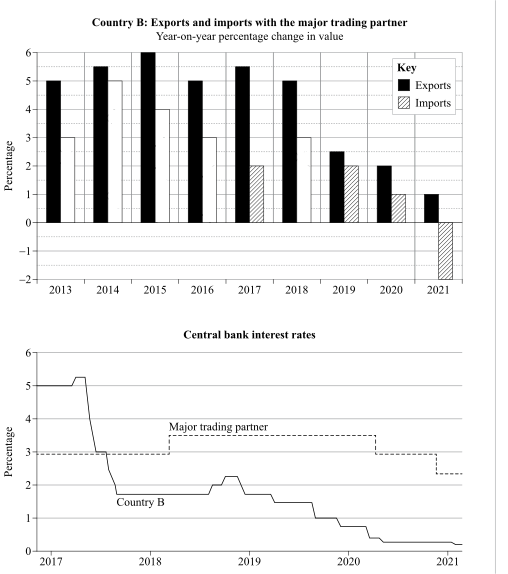
Country B: Exports and imports with the major trading partner
Interpret the trend in Country B’s trade balance to draw a conclusion about whether its own or the major trading partner’s interest rates will have a greater effect on Country B’s economic growth. Assume the exchange rate of Country B is fixed.
QCAA guide · typeset solution
QCAA sample response and mark allocation
Q | The response: | Notes |
13 | Trends (7 marks) | |
• quantifies the trend in export data [1 mark] • draws meaning from the export data [1 mark] • quantifies the trend in import data [1 mark] • draws meaning from the import data [1 mark] • makes a connection between trade data and cash rates of major trading partner [1 mark] • quantifies the trend in MP [1 mark] • interprets the trend in MP as expansionary [1 mark] | ||
Conclusion (5 marks) | ||
• identifies the relative ineffectiveness of ↓ domestic interest rates further, based on economic growth [1 mark] • explains the decision made on domestic MP effectiveness, with no major flaws [1 mark] • identifies that the trading partner’s interest rates will have a positive impact on Country B [1 mark] • explains the decision made on trading partner’s MP effectiveness, with no major flaws [1 mark] • provides accurate reasoning regarding a potential ↑ in export demand, which would have a stimulatory impact on EG in Country B [1 mark] | ||
Sample response | ||
Country B’s exports, a circular flow injection, have fallen from 6% in 2015 to a low of 1%, indicating their major trading partner has been experiencing falling domestic demand — supported by the trading partner’s interest rates falling from 2020 to 2021. Country B’s imports, an indicator of domestic demand, have fallen consistently from 5% in 2014 to – 2% in 2021, signifying Country B has also lower domestic demand for imported capital resources and goods and services. The monetary policy trend of Country B is expansionary, based on the primarily downward movements in interest rates from a peak of 5.25% in 2017 to a current low of 0.25% since mid-2020. As interest rates have been low for three years, it is unlikely that domestic interest rates would be effective in encouraging economic growth in Country B. What is likely to assist with Country B’s economic growth is expansionary monetary policy by the major trading partner, because it has room to lower interest rates from 2.5% to further stimulate their economy. As their economy recovers, the greater spending on exports from Country B will increase the injection of income into Country B, which should, given the circular flow model of income, cause Country B’s economy to grow. | ||
QCAA sample response and marking criteria reproduced from the official guide.
Compare your working with the guide above.