QUESTION 13 (25 marks)
Use Sources 8–14 in the stimulus book to evaluate which policy would be a more effective response to Australia’s ageing population: a policy that targets incentives to save for retirement or a policy that targets labour supply.
Stimulus book
Source 8
Australia’s population projections: Percentage of total population
Age group
2015 2055
0–14
18.8 17.4
15–64
66.2
60
65–84
13 17.7
85 and over
2 4.9
Note: Assume Australians are eligible for the age pension from 65 years of age.
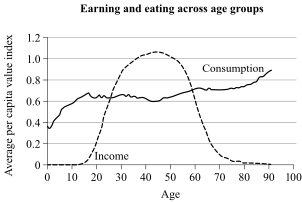
Source 9
Source 10 Ratio of household income saved to household net disposable income in Australia
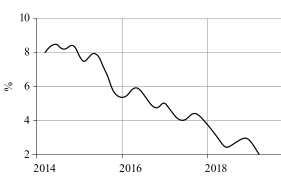
2020
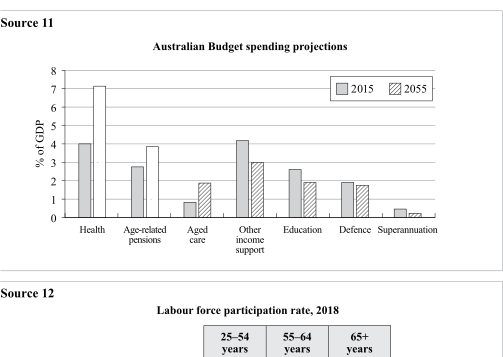
25–54 years | 55–64 years | 65+ years | |
Australia | 84.4 | 66.7 | 14.0 |
Canada | 87.0 | 66.5 | 14.0 |
USA | 82.1 | 65.0 | 19.6 |
Japan | 87.4 | 77.0 | 24.7 |
New Zealand | 87.4 | 79.9 | 24.2 |
Korea | 79.3 | 68.8 | 32.2 |
OECD | 82.4 | 63.9 | 15.3 |
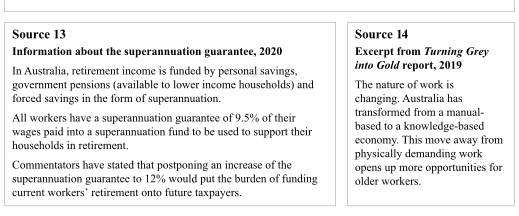
In Australia, retirement income is funded by personal savings, government pensions (available to lower income households) and forced savings in the form of superannuation. All workers have a superannuation guarantee of 9.5% of their wages paid into a superannuation fund to be used to support their
Commentators have stated that postponing an increase of the superannuation guarantee to 12% would put the burden of funding current workersʼ retirement onto future taxpayers.
QCAA guide · typeset solution
QCAA sample response and mark allocation
Extended response — Question 13
Analysing (13 marks)
The response: | The response: | M | The response: | M |
Problem | Age (Source 8) | Consumption (Source 9) | ||
• describes the economic problem (s11) [1 mark] • identifies a rationale for government intervention [1 mark] • provides a reason to support the rationale [1 mark] • calculates a number to make meaning [1 mark] | • quantifies the projected ↑ in both trends • effectively provides a detailed interpretation of both trends | 5 | • quantifies the pattern of income and consumption • effectively provides a detailed interpretation of the pattern | 4 |
• quantifies the projected ↑ in both trends • interprets a relationship to both trends | 4 | • quantifies the pattern • interprets a relationship to the pattern | 3 | |
• quantifies the projected ↑ in both trends • interprets a relationship relevant to a trend | 3 | • identifies the pattern • interprets a relationship to the pattern | 2 | |
• identifies the projected ↑ in a trend • interprets a relationship relevant to a trend | 2 | • identifies the pattern | 1 | |
• identifies the projected ↑ in a trend | 1 | • does not satisfy any of the descriptors above. | 0 | |
• does not satisfy any of the descriptors above. | 0 | |||
Evaluating (12 marks)
The response: | M | The response: | M | The response: | M |
Savings | Labour | Conclusion | |||
• explains the efficacy of targeting HH savings • effectively uses economic reasoning and data to discuss the policy’s potential | 4 | • explains the efficacy of targeting labour supply • effectively uses economic reasoning and data to discuss the policy’s potential | 4 | • draws a valid conclusion about which policy should be used, based on a relevant economic criterion • effectively synthesises economic ideas and perspectives to support the conclusion | 4 |
• explains the efficacy of targeting HH savings • uses economic reasoning linked to the sources to discuss the policy’s potential | 3 | • explains the efficacy of targeting labour supply • uses economic reasoning linked to the sources to discuss the policy’s potential | 3 | • draws a valid conclusion about which policy should be used • synthesises economic ideas or perspectives to support the conclusion | 3 |
• describes the efficacy of targeting HH savings • uses some reasons to indicate the policy’s potential | 2 | • describes the efficacy of targeting labour supply • uses some reasons to indicate the policy’s potential | 2 | • draws a plausible conclusion about which policy should be used • uses an economic idea or perspective to support the conclusion | 2 |
• uses a reason to indicate the efficacy of targeting HH savings | 1 | • uses a reason to indicate the efficacy of targeting labour supply | 1 | • draws a conclusion about which policy should be used | 1 |
• does not satisfy any of the descriptors above. | 0 | • does not satisfy any of the descriptors above. | 0 | • does not satisfy any of the descriptors above. | 0 |
QCAA sample response and marking criteria reproduced from the official guide.
Compare your working with the guide above.