QUESTION 12 (13 marks)
Use Sources 4–7 in the stimulus book to evaluate the extent to which monetary policy is the appropriate policy lever to improve economic prosperity for Australian low-income households.
Stimulus book
Source 4 Percentage of disposable household income needed to pay the average electricity bill, 2019
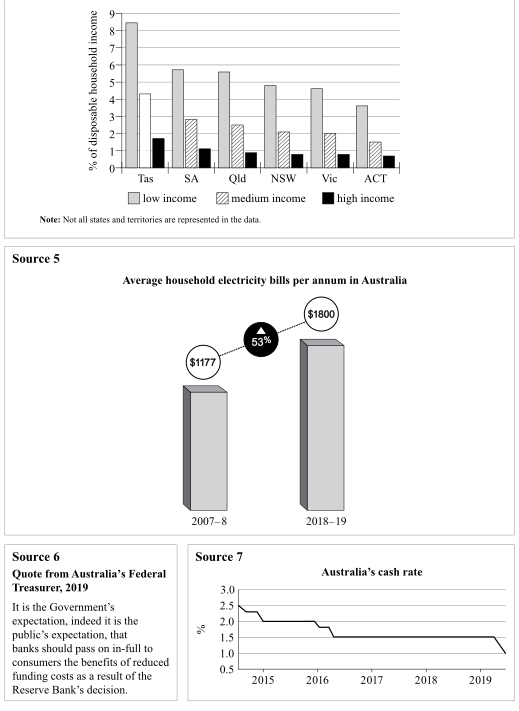
Note: Not all states and territories are represented in the data.
Average household electricity bills per annum in Australia
QCAA guide · typeset solution
QCAA sample response and mark allocation
Q | Sample response | The response: | The response: | M | The response: | M |
12 | The data identifies the economic issue of Australia’s electricity prices becoming less affordable over time, which is a problem for the living standards of all Australians. In particular, lower income households in all states have less disposable income to absorb increasing prices (except for WA with no data provided). These households pay 30–50% more on electricity than medium-income households as a percentage of disposable income. Further, Tasmanian consumers suffer the highest electricity prices in proportion to average incomes. Specifically, low-income Tasmanian households pay more than 8% of disposable income on electricity bills, compared with 3.5% in the ACT. The broad objective of monetary policy to support the economic welfare and prosperity of Australians indicates the policy lever is not effective to ease electricity price inflation pressures in this situation. Monetary policy is a blunt economic tool, because cash rate movements cannot be targeted to improve the standard of living of those who are suffering most from electricity price increases. It also has an effectiveness lag, as cash rates tend to influence economic activity in the medium term — not immediately when assistance is needed — because they are dependent on banks passing on cash rate movements. Finally, at current low rates of 1%, it is unlikely that lowering cash rates further would improve the economic welfare or prosperity of those in need, because interest rates are so low as to be ineffective. | Issue | Decision | Reasoning | ||
• describes the economic issue that electricity prices are less affordable over time (s5) [1 mark] • identifies a relevant reason for the economic issue being important [1 mark] • quantifies the pattern/trend of ↑ electricity prices linking to - disposable Y of low-income HH (s4) [1 mark] - Tasmanian HH (s4) [1 mark] • interprets an identified pattern/trend [1 mark] • calculates a number to make meaning [1 mark] | • makes a valid decision about the effectiveness of MP (s4) • uses economic prosperity as a criterion to support the decision | 3 | • effectively uses economic reasoning to support the decision • effectively synthesises an economic idea and links to a perspective | 4 | ||
• makes a valid decision about the effectiveness of MP • identifies a link to economic prosperity | 2 | • uses economic reasoning to support the decision • links to an economic idea and a perspective | 3 | |||
• makes a plausible decision about the effectiveness of MP | 1 | • uses a plausible economic reason • links to an economic idea and a perspective | 2 | |||
• does not satisfy any of the descriptors above. | 0 | • identifies a plausible economic reason | 1 | |||
• does not satisfy any of the descriptors above. | 0 | |||||
QCAA sample response and marking criteria reproduced from the official guide.
Compare your working with the guide above.